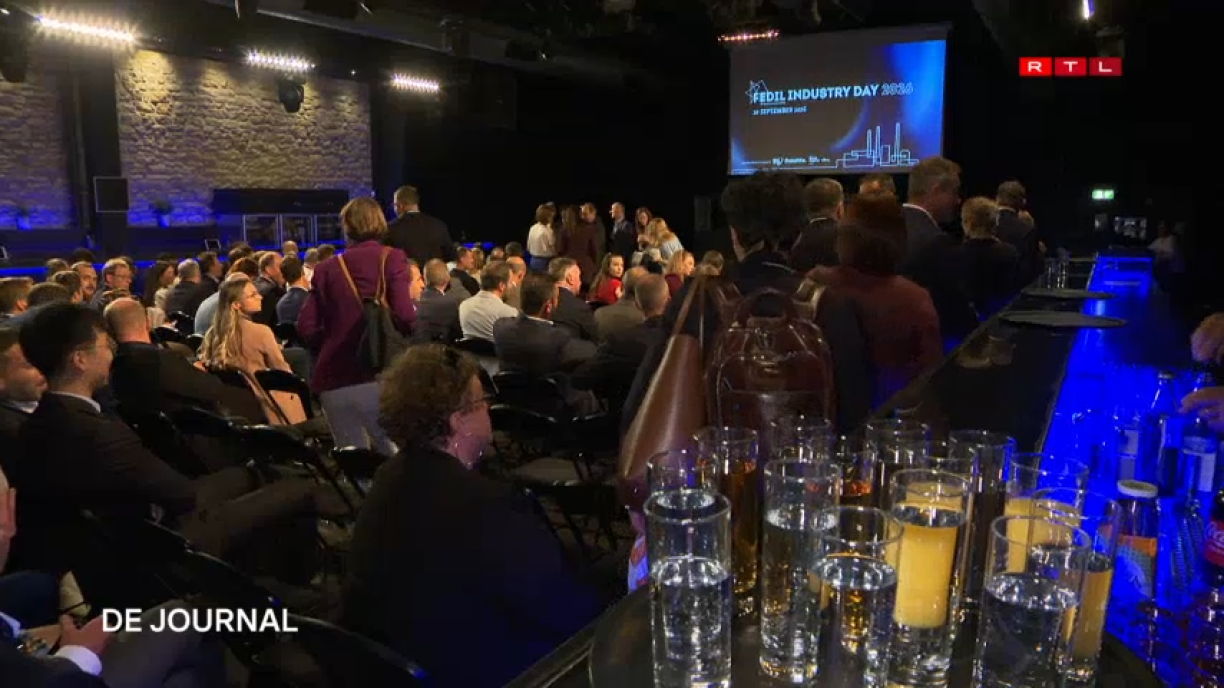
Over 250 guests were invited to Hollerich by the Luxembourg Federation of Industrialists (Fedil) for this year’s Industry Day. The focus was firmly on strategic autonomy; specifically how Europe, in a rapidly changing world, can reduce its dependencies and strengthen its position on the global stage.
The event’s keynote speaker, Tanja Gönner, CEO of the Federation of German Industries (BDI), made clear that we will win the battles currently taking place in the world markets only if we remain competitive.
Participants agreed that Europe must accelerate energy transition and reduce administrative hurdles if it wants to close the competitiveness gap with global rivals.
Frederik Debrabander of Deloitte, a former engineer, highlighted that European companies require a third more staff for administrative tasks compared to the United States, and 10 times more than in China.
Tanja Gönner argued that businesses need more trust from governments and that regulation should focus on creating a clear framework and objectives, rather than prescribing every detail. The aim, she said, should be to give companies the freedom to innovate and develop new products instead of being bogged down by bureaucracy.
Gönner insisted the need for flexibility extends to the energy transition as well. While the European goal of climate neutrality by 2050 should not be up for debate, she criticised the increasing tendency to prescribe in detail how each sector should achieve this target.
Instead, politicians should define the goal and allow companies to choose which technologies they use to get there. At the same time, it is important to clarify which infrastructure is needed, who is responsible, and how it will be financed.
Despite clear blueprints, such as the Draghi report and the Antwerp Declaration, industry representatives lamented that barely a fifth of recommended reforms, particularly those aimed at cutting red tape, have been implemented.
Alex Schumann, President of Fedil, stressed that they know exactly what needs to done; they just need to start. He questioned whether slow progress is due to a lack of coordination or because individual countries are clinging to their national interests.
Schumann also argued that for Europe to fully leverage its strength as one of the world’s largest markets, there must be "more union within the Union".
According to him, Luxembourg’s scope for manoeuvre, especially in the energy sector, is limited by its reliance on Germany’s electricity grid and Belgium’s gas network, which makes it vital that the country’s positions are heard in Brussels.
Turning to recent political developments in Europe, Schumann argued that the best way forward is to focus on economic policy. A robust economy that delivers prosperity for all, he said, is also the best antidote to the rise of extremist movements. That is why competitiveness matters not just to business leaders, but to society as a whole.
Tanja Gönner, who previously served as a CDU minister in Baden-Württemberg, underlined that her role as an industry representative is to highlight the conditions businesses need to succeed.
She cautioned that parties advocating withdrawal from the Schengen area, opposing the euro, or restricting foreign labour, are not acting in the interests of export-driven industries in Germany, or elsewhere in Europe.
Unlike in previous years, wage costs provoked little concern among industry leaders at this event. Instead, trade agreements were singled out as a positive development. Schumann pointed to progress in recent years, citing links with South America, ongoing developments with India, and deepening ties with Canada – now a more attractive trading partner for Europe.
These successes, he said, are a "bright spot" in a landscape where progress on other important reforms remains slow.





