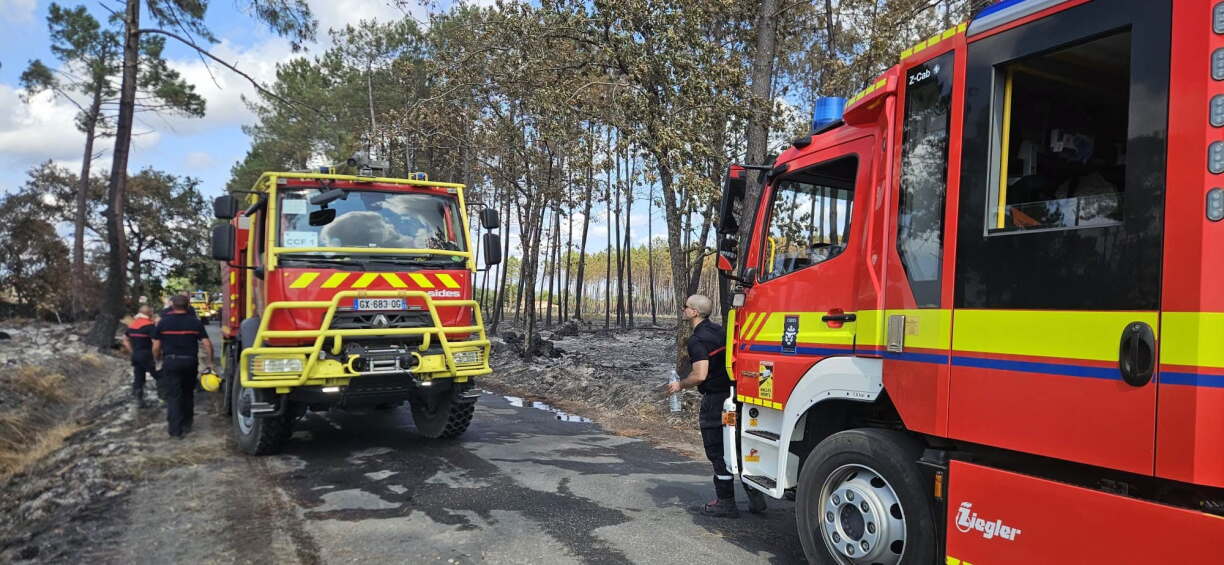
The Gironde region in south-western France has just endured one of the most devastating wildfires in its history, with approximately 42,000 hectares of forest destroyed and more than 220,000 people evacuated, both residents and tourists.
Over 2,200 firefighters were deployed to combat the blaze, including a delegation from Luxembourg sent to support their French counterparts. By the time the Grand Ducal Fire and Rescue Corps (CGDIS) team arrived, the largest flames were under control but firefighting efforts were still far from finished, as Jean-Luc Rind, head of the Luxembourg mission, explained.
The real problem here is the peaty soil, Rind noted, which means the fire will continue to smoulder for a long time. Pockets of fire keep flaring up in the heat below ground, and any area not yet burnt can reignite at any moment. "Our main job was constant patrolling – what they call reconnaissance. Whenever we spotted a flare-up, we would extinguish it to prevent further spread", he explained.
Even experienced firefighters were taken aback by the scale of the disaster.
The fifteen-strong Luxembourg team faced substantial challenges throughout their deployment, and "none of them had ever seen anything of this magnitude", Rind confessed.
The severity of the situation also put enormous pressure on both crews and equipment.
According to Rind, the exhaustion was evident on the faces of local firefighters and in the condition of their vehicles. Some of the fire engines, although new, "now look twenty years old after just one week of continuous operation".
The trucks have been exposed directly to the flames, and many firefighters have barely slept. "They have all been working around the clock", Rind reported.
Luxembourg's firefighters were particularly struck by the solidarity shown by the local population.
"We were received with open arms, even by people who had lost everything", Rind said.
He recalls seeing villagers taking charge of providing supplies for all the crews. Local businesses, including some from Bordeaux, donated goods, while villagers themselves cooked for everyone.
This sense of solidarity touched the head of Luxembourg's mission even more than the European solidarity, which was also immense and essential, since the French teams could not have coped alone.
According to Rind, this serves as a "powerful reminder that in times of major disaster, people still come together to support each other – something which is not always a given these days".
Beyond solidarity, the most lasting image is that of a dramatically altered landscape. Entire neighbourhoods and roads have been destroyed, which naturally raises questions about the future for those affected.
Rind describes the landscape as "striking". On some streets, maybe one house remains while everything else is burnt. The images are grim now, but what really stays with him and his people is the future of the villagers, as even those whose homes survived have lost their neighbours.
According to him, all the forests here will have to be cleared eventually, and "the people are left living in a desert. This area relies on tourism, but it will not be attractive for years to come", Rind reflected.
The Luxembourg firefighters return home with hard-won experience and the recognition that Europe will increasingly face such extreme weather events, and that Luxembourg must continually prepare for new challenges. For now, Luxembourg is well equipped to meet them, Rind concluded.
A large number of helicopters and firefighting planes, including one sent by Luxembourg, were deployed in the Gironde. These aircraft played a crucial role in the operation and will likely become even more important in future disaster responses, Rind observed.