Luxembourg has been grappling with an extended period of drought and heat, a combination that is putting significant pressure on the country’s drinking water reserves. As a result, many local authorities across Luxembourg are urging residents to save water wherever possible. Parc Housen is leading by example with a practical solution designed to reduce water waste and support local needs.
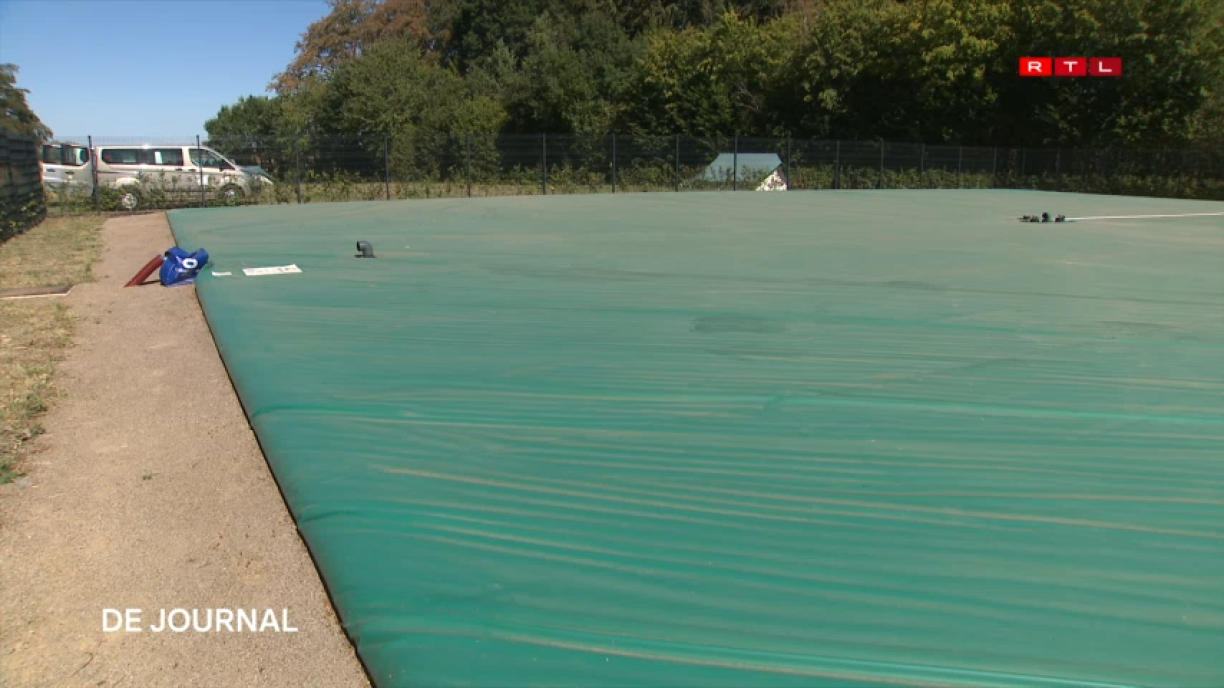
Anyone passing through Parc Housen may have noticed a large, unfamiliar structure tucked just behind the artificial football pitch – a sizable water pouch, which at first glance might be mistaken for an oversized bouncy castle. In fact, this pouch can hold up to 1,200 cubic metres of water, sourced both from rainwater (though rainfall has been scarce recently) and, importantly, from nearby facilities.
Romain Wester, Mayor of the Parc Housen municipality, explains how the system works. Over the coming days, the swimming pool will close for about 10 days for maintenance. During this period, around 1,200 cubic metres of water will be released from the pool and channelled into the pouch. This ensures we have a water reserve for irrigating the fields until the wetter seasons return, like late autumn or early winter.


The stored water is primarily used to irrigate the adjacent football fields, typically at night, unless the process is being filmed for television. In addition, the local fire brigade can access the water in the pouch for firefighting if necessary. If the pouch were not installed, the dechlorinated pool water would simply be discharged into the River Our. The pilot project, which cost around €200,000 (of which €175,000 was covered by the state), is intended to demonstrate efficient water use at the municipal level. Meanwhile, the effects of the drought are starkly visible in places like Bavigne near the Upper Sûre Lake, where the Béiwener stream has dried up almost completely for the second time since 2022.
Brigitte Lambert, unit head at the Water Management Agency, emphasises that streams and rivers are under immense stress. For decades, humans have altered their natural course by straightening and channelling them, making them less resilient. The stress they experience under normal conditions is now being amplified by this summer’s high temperatures and prolonged drought.
When it comes to saving water, every individual can make a difference with relatively simple actions. Lambert explains that a quick shower with a water-saving showerhead uses roughly the equivalent of two six-packs of bottled water, compared to about eight six-packs for a conventional shower. For flushing toilets, drinking-quality water isn’t required; rainwater or treated groundwater can be used instead, replacing the equivalent of four six-packs of drinking water with water from alternative sources.
Businesses, the state, and local councils can also play their part in conserving water. For particularly innovative research projects, the state is even willing to cover 100% of the associated costs.