The report, which was published by Unicef on Thursday, ranks Luxembourg 13th out of 41 participating countries. Member states of the Organisation for Economic Co-operation and Development (OECD) and the European Union (EU) were evaluated based upon three distinct criteria: mental well-being, physical health, and skills.
The Grand Duchy ranks second in physical health, only Japanese children are seen as fitter and healthier. The study considers both child mortality and obesity. Luxembourg has the lowest mortality rate, while Mexico has the highest. According to Unicef, a country's child mortality rate can be seen as indicative of national wealth and inequalities. The US form an exception as being one of the wealthier countries to have an elevated mortality rate.
The second classifier for physical health is obesity. The overall rate of overweight children has been on the rise in recent years, and it appears it will continue to do so in the foreseeable future, which can have detrimental effects on both physical and psychological well-being. In Luxembourg, 26% of children and adolescents between the age of 5 and 19 were overweight in 2016. The tally is the lowest in Japan (14%) and the highest in the US (42%).
45% of 11, 13, and 15-year-olds across the world's wealthiest countries report dissatisfaction with their own bodies, and more feel overweight than underweight. It is noteworthy in that regard that although more boys at the age of 15 are overweight than girls (27 and 23%), the rate of boys who claim to be dissatisfied with their weight is lower than that of girls (24 and 34%). Unicef further concludes that many children report discontent with their body images before even reaching adolescence.
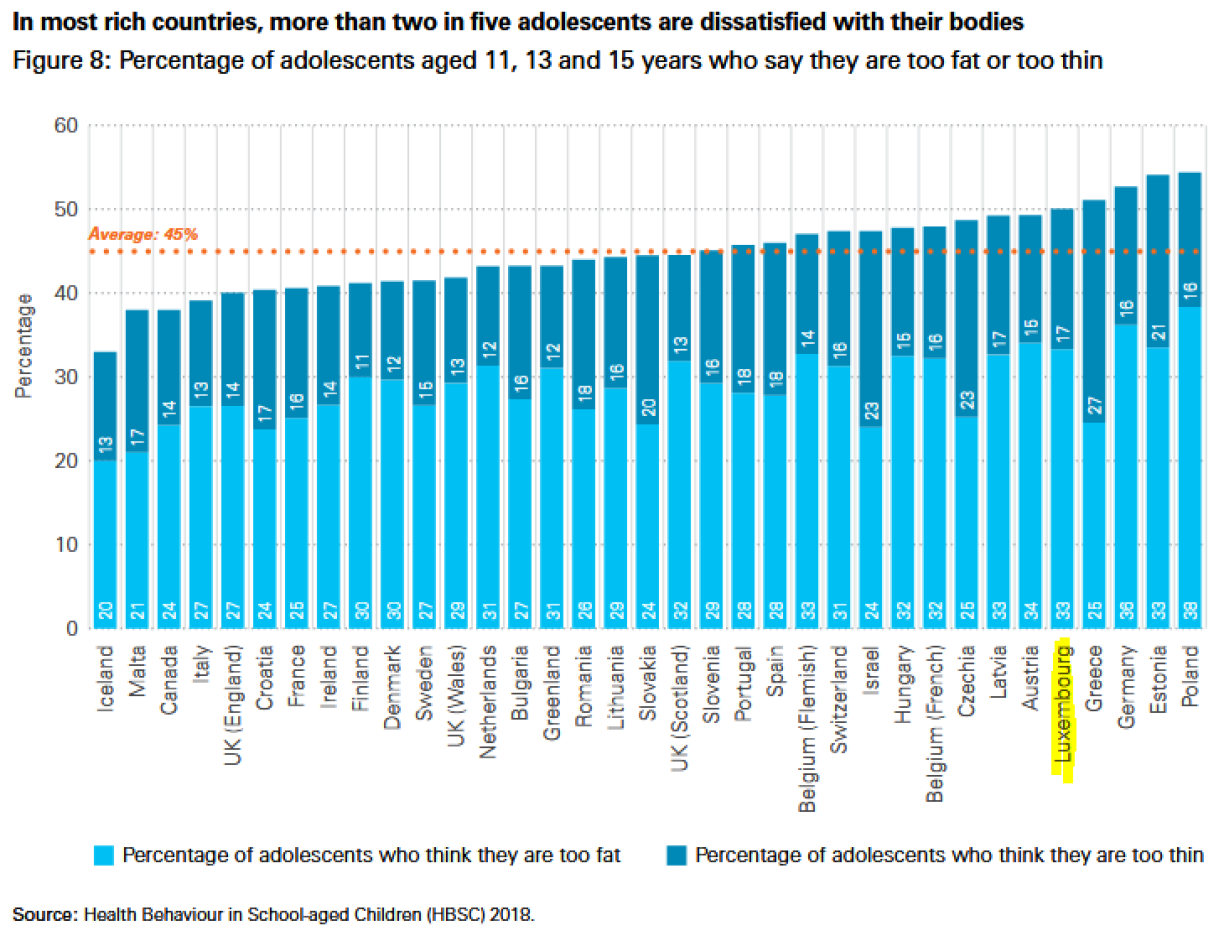
In general, the bodily self-evaluation has more significant impacts on the well-being of girls than that of boys. Luxembourg seems to be an exception to this rule however, with an average of 4% for both boys and girls.
When it comes to mental well-being, the Grand Duchy finds itself in the middle of the pack. 76% of 15-year-olds in Luxembourg claim to not be fully satisfied with their lives. In comparison, in the Netherlands, 90% of children report to be satisfied, while Turkey has the lowest tally with only 53%.
Unicef also looked at the suicide rate as an indicator of mental well-being.
The Grand Duchy ranks less favourable when it comes to skill sets, which can be explained by the fact that Unicef relies on the PISA tests for their assessment, in which Luxembourg's pupils are known to have their fair set of difficulties. Only 7 other countries have lower rates of basic math and reading skills than the Grand Duchy with 56%. Estonia ranks highest in that category.
Unicef also considered social skills in their evaluation, as for instance the ability to find new friends. 75% of Luxembourgish children believe this to be easy. The highest rate can be found in Romania, the lowest in Chile.
Meanwhile, most adolescents in Luxembourg are either in school, doing an apprenticeship, or working. In 2018, only 1.5% of children between the age of 15 and 19 were not, a clear decrease since 2010 (6%).
Children who spend most of their time playing outside are in general more satisfied than others. Screen time, which has been on the rise in recent years, does not seem to have as much of a negative affect as previously thought. Unicef emphasised nevertheless that moderation would play a key factor in that aspect.
Good family relations have a positive impact on well-being. In Luxembourg, only 40% of children who claim not to be supported by their parents indicate to be content.
The Unicef report clearly indicates that even in the world's wealthiest countries, many children are still struggling. Gunilla Olsson, director of Unicef Innocenti and author of the report, notes that almost in half of these countries, including Luxembourg, 1 out 5 children still lived in poverty.
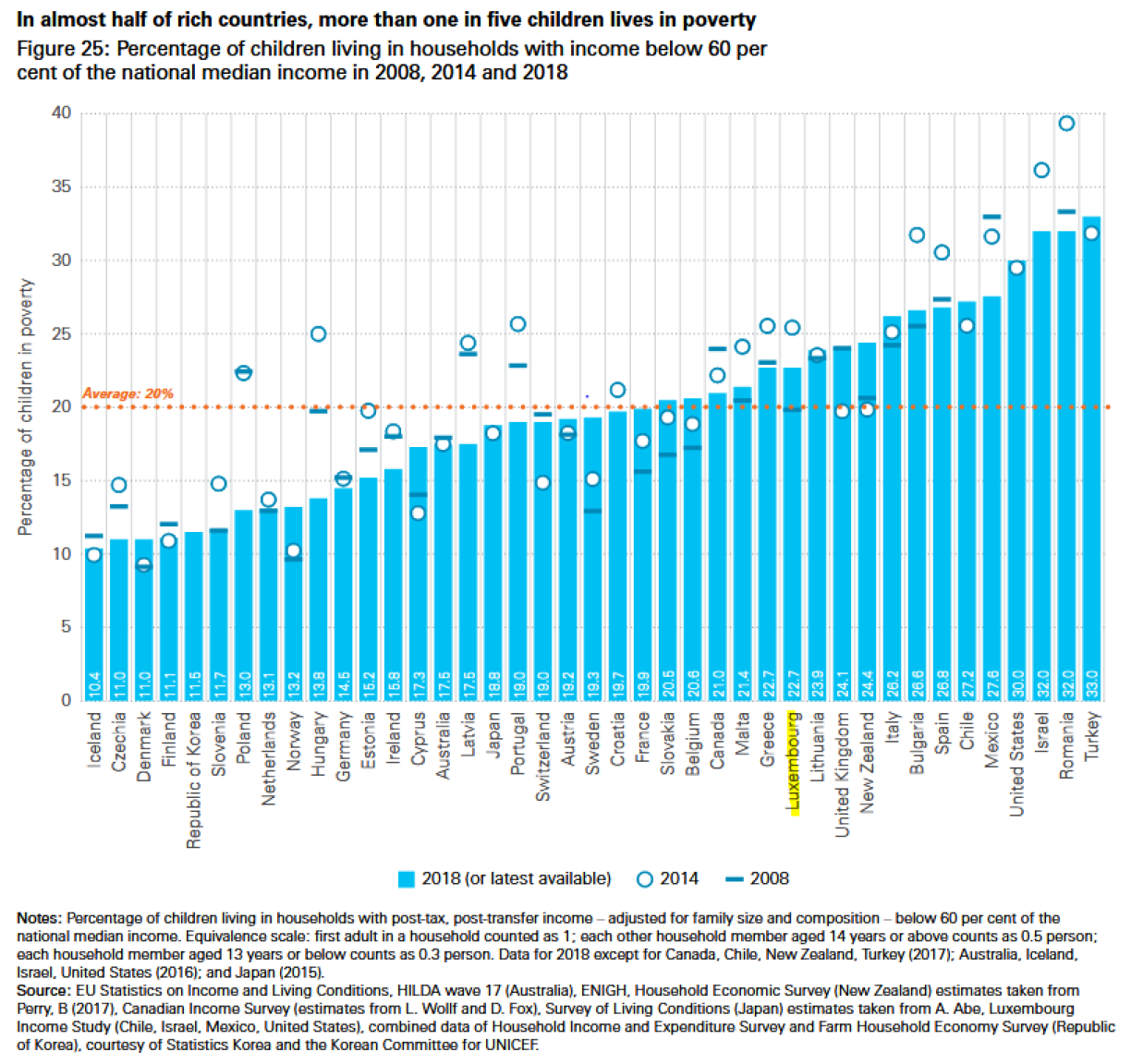
The corona crisis might worsen the situation, especially since many schools were forced to close for a significant amount of time. Olsson underlines that pandemic-related family and child support is often by far not enough. Paired with the pending recession, the rate of child poverty could be on the rise again in the foreseeable future.
Unicef offers a series of measures to counteract this tendency: better inclusion of children in decision-making processes, unified policies against inequality and poverty, improving access to nurseries and mental health services for children as well as adolescents, family-friendly work policies, reducing air pollution, and even improving the protection of avoidable diseases. The last measure is considered a reaction to the growing tendency of refusing vaccinations in recent years.
According to the report, Norway, Iceland, and Finland have adapted the most efficient political policies to counteract the decline in well-being of their children and adolescents. Luxembourg ranks 7th in that category.





