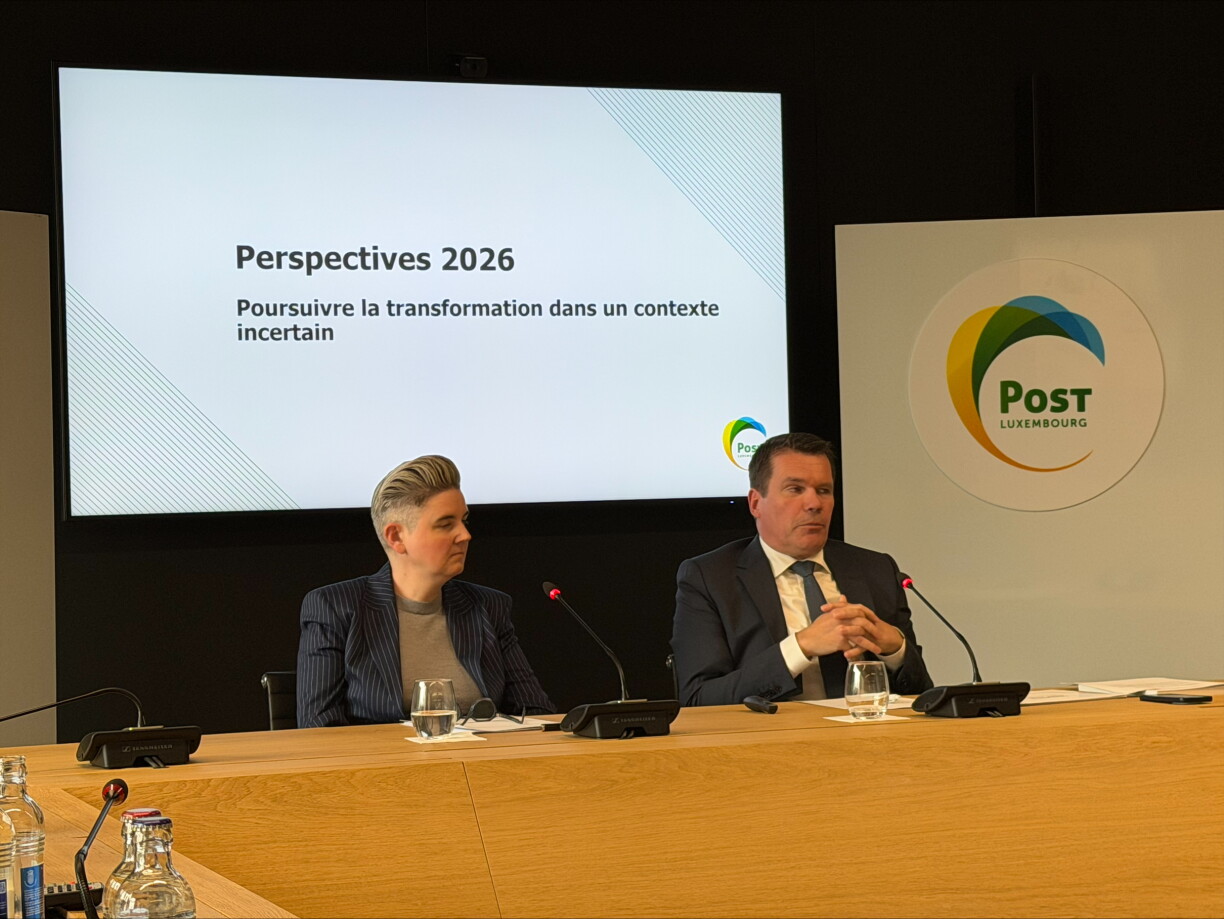
The Post Group presented its annual report for 2025 on Tuesday, with Post Luxembourg reporting only marginal growth.
The year was marked by geopolitical and economic uncertainties. Turnover reached €985 million, an increase of just €7 million compared to the previous year. Historically speaking, this constitutes very slow growth, acknowledged Director General Claude Strasser during the press conference.
After costs and taxes, the company posted a profit of €31 million, which is €19 million less than in 2024.
The Post Group's main pillars are now telecommunications and ICT. These include the Pop brand for private individuals and the new DEEP brand for businesses. Post Luxembourg is focusing particular attention on DEEP, seeing strong potential in cloud services, data centres, and artificial intelligence.
Post Telecom accounts for two-thirds of turnover, generating €646 million. However, remaining competitive in telecommunications requires very high levels of investment due to the rapid pace of development.
The second pillar consists of Post Luxembourg's financial services, which are also undergoing a transformation. According to Strasser, business in this area is highly dependent on interest rates.
Traditional mail exchanges are becoming increasingly less significant, whereas Post handled and delivered 10 million parcels last year. The new logistics centre in Bettembourg, expected to be completed in 2028, has become essential.
Despite what Strasser described as a solid result within a difficult context, cost control presents a major challenge. Post Luxembourg pays out nearly half a billion euros in wages, meaning each wage indexation has a significant impact. Additionally, the prices of products containing electronic components are rising sharply.
The sector in which the Post Group operates is undergoing rapid changes on a European scale. With the Digital Network Act, the legal framework is also set to change fundamentally in the near future. Post Luxembourg will have to continually adapt to these rapid developments, emphasised Françoise Schlink, Chairwoman of the Administrative Board.