The number of illegal border crossings into the European Union fell sharply in the first nine months of 2026.
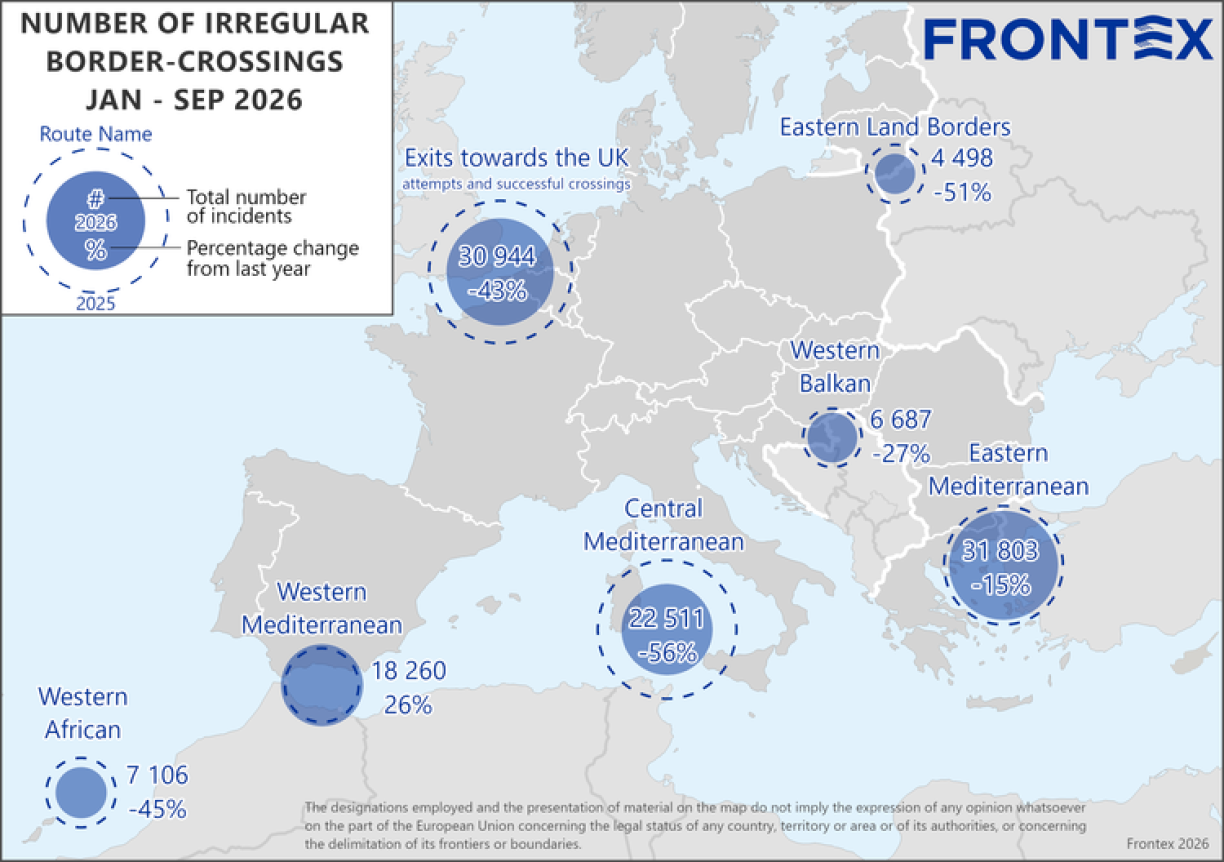
According to preliminary data from the European border protection agency Frontex, just over 91,000 border crossings were registered, almost a third fewer than in the same period a year earlier.
The decline can be seen on almost all the main migration routes.
Frontex puts it down, among other things, to increased cooperation with partner countries and to preventive measures in the most important countries of departure.
In September alone, around 14,300 illegal border crossings were detected, a 28-percent drop compared to September 2025.
Compared to August, however, the figure was up 11%, in part thanks to improved weather conditions on the sea route.
The biggest drop was recorded on the central Mediterranean route.
Here, the number of arrivals fell by 56% to around 22,500. Libya remains the most important country of departure on that route, accounting for around three-quarters of departures.
Tunisia and Algeria also play a role. The most common nationalities were Bangladeshi, Algerian and Somali.
Another trend has emerged on the western Mediterranean route. It is the only major migration route on which the numbers have risen.
With around 18,300 border crossings registered, that marks a 26% increase compared to the previous year.
At the land border in particular, the numbers have more than doubled. Arrivals by sea were up 8%.
Despite the overall decline, the human cost of migration remains high.
According to data from the International Organization for Migration (IOM), almost 2,000 people have died in the Mediterranean since the start of the year.
Many migrants risk their lives in heavily overcrowded boats, which are often not fit for the sea.
Frontex points out that smugglers continue to send people on risky journeys despite the dangers and poor navigation conditions.
International developments, too, could affect migration movements in the coming months.
In particular, the large numbers of Afghans being sent back from Iran to Pakistan, as well as the political instability in the Sahel region in Africa, could trigger new migration flows towards Europe.
So far, however, these developments have had no major impact on the numbers at the EU’s external borders.
As part of the new EU pact on migration and asylum, which provides, among other things, for uniform control procedures at the external borders, Frontex also supports member states with establishing nationality, collecting biometric data and checking identity documents.
The agency currently has around 3,800 Frontex officers on duty at the EU's external borders.
Their role is to support national authorities with border protection and to help save lives at sea.
Even if the numbers are currently notably lower, the situation at Frontex remains unstable.
In particular, the rapid shifts on individual migration routes show that developments will need to continue to be closely monitored.