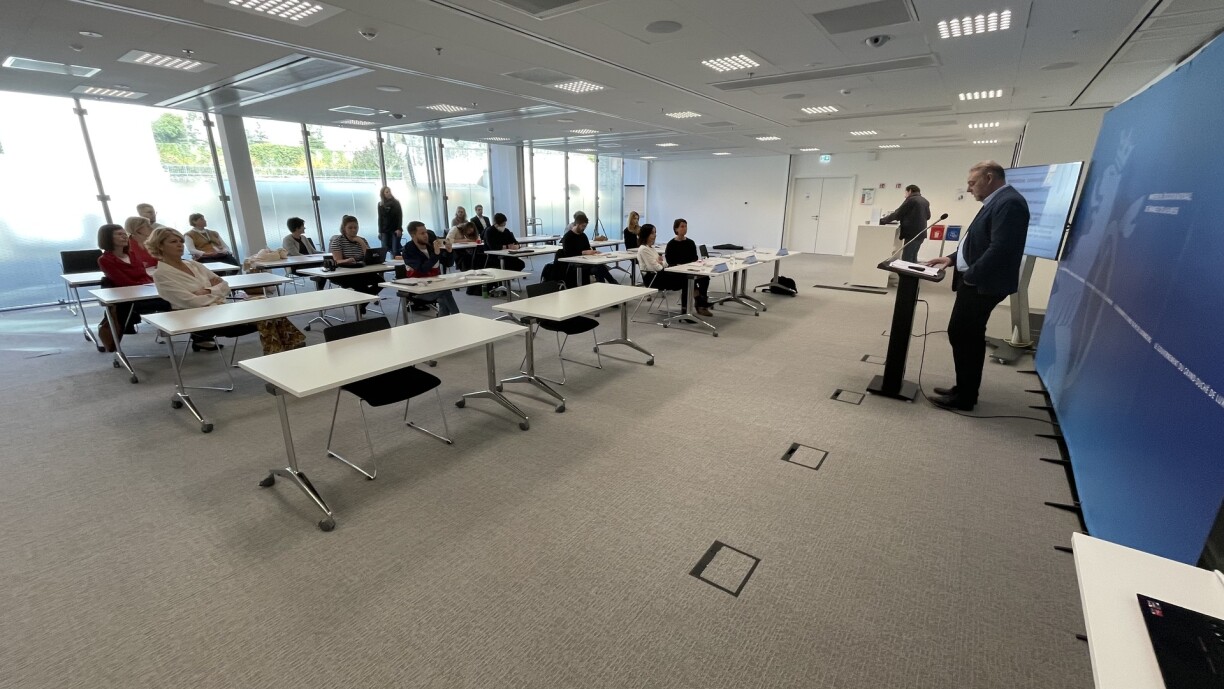
The first national children's report was carried out by the Ministry of Education, the universities of Luxembourg and Tübingen and the LISER.
Children up to 12 were asked about their participation in civic life and leisure activities. The study was interested in every area of life for children up to 12 years old.
Those above 8 years old were interrogated directly, once in 2019 and again in 2021. So while the pandemic wasn't the reason for the study, it certainly influenced the results.
Having a say is of central importance for children's wellbeing, said professor Sascha Neumann of Tübingen University, who led the study along with two other authors. Children in Luxembourg said they felt safe and well cared for, but were less in agreement regarding participation in daily life.
"What's particularly surprising is that this does not increase with age. You would expect that a twelve year old has more of a say than an eight year old. In Luxembourg, this actually decreses."
This is different in Germany, for instance. The result shows there is potential for improvement. Children's participation in decision-making at home and at school should be promoted.
Of course, the pandemic had an impact on the study, although Children's satisfaction has generally not decreased in that timespan.
For Minister of Education Claude Meisch, this is "proof that leaving schools and maisons relais open as much as possible was the right decision. In other countries, where this wasn't the case, the picture may be different."
Children did state in the 2021 questionnaire that their parents were often more stressed due to the pandemic. Generally, kids were more impacted by the social consequences of restrictions than worries about health. But even if general satisfaction did not drop significantly, there were noticeable changes.
"For instance around leisure behaviours", says Sascha Neumann. "Children spent more free time on social media than with their friends or at a sports club. We also noticed that children were more likely to meet their friends online than in person."
Claude Meisch added that this had been the first period in a very long time that registrations at music schools had stagnated rather than increased.
Many children also never returned to their previous leisure organisations. The Ministry of Education is planning to counteract this trend by promoting music schools, for instance.
The report is intended to be repeated every five years, with individual aspects being studied in more detail - for instance, whether success at school has an impact on children's wellbeing.





