While Luxembourg always seems to scare away from every new edition of the international PISA tests, countries like Finland have managed to excel over the course of recent years and through the implementation of numerous educational reforms.
The Finnish system is in fact quite simplistic and based on a small number of premises: free education and school material, a manageable schedule, fewer exams, and less homework. On average, a Finnish teacher only conducts four hours of class a day, which is far below the average European average.
Finnish pupils have systematically come out on top of the PISA results in science, mathematics, and reading for little over a decade now. Proof enough that the Finnish approach is the right path forward?
Luxembourg rarely performs well on the other hand and even finished below the OECD average in 2018. The report even went as far as to declare a "systematic lack of basic maths and reading skills:"
Claude Sevenig, a representative of the ministry of education and in charge on international relations, underlined in that regard in Luxembourg, a majority of pupils (83%) have to learn mathematics and other sciences in a language different from their native one, a problem for both Luxembourgish and foreign children. She acknowledged that in a way, the national education system prioritised languages over sciences, but explained that many adaptations had already been initiated over recent years.
According to the representative, the ministry's new approach will be more "individualised and humane" in nature, and take inspiration from the successful Scandinavian and Nordic models.
The Nordic nation is known to have a more digestible school schedule, but how far do Luxembourg and Finland differ?
In 2019, the Grand Duchy reported 810 hours of class in primary education, and 739 in secondary education. Finland on the other hand ended the same academic year with 677 and 592 hours respectively. The difference becomes even more noticeable, given that in Luxembourg the average amount of homework also exceeds that of Finland.
This factor could be related to a more elevated drop-out rate in secondary education in the Grand Duchy, which is currently set around 20%. Only Colombia and Mexico had higher tallies.
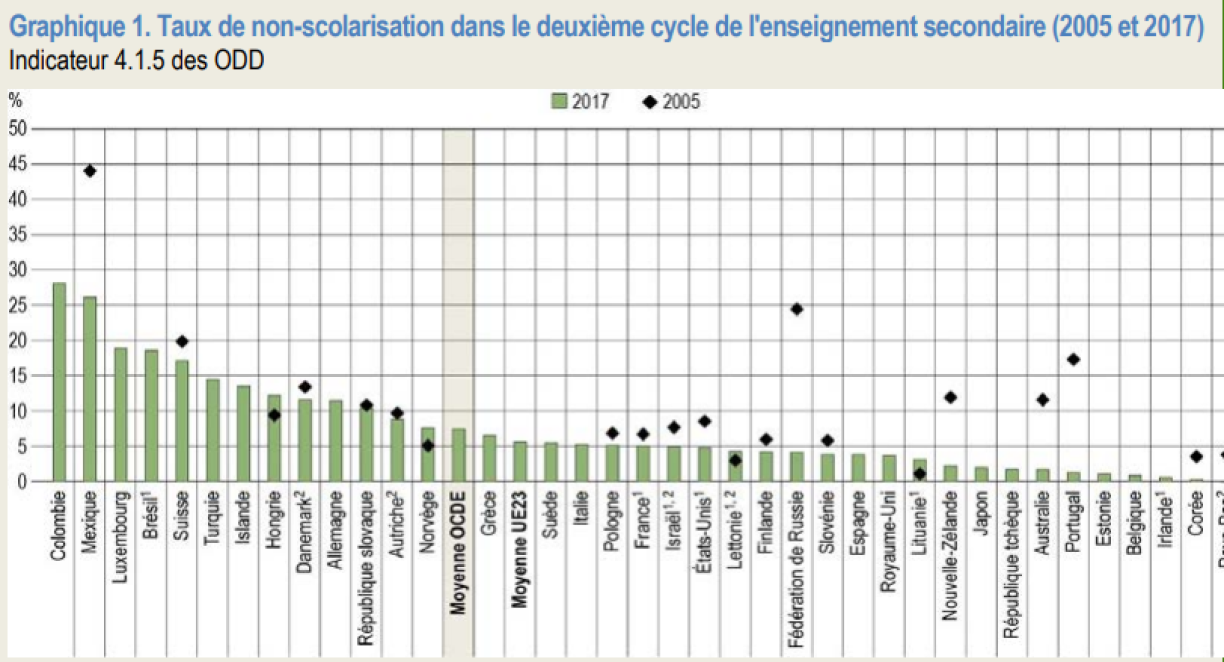
Sevenig emphasised in that regard that the report numbers would not accurately reflect the actual rate, which she declared to be below the EU average of 10%: "Naturally, we would like for our tally to be at 0%, but so far, we have channelled many efforts to facilitate a return to school for former drop-outs."
When it comes to the lighter schedule, Sevenig acknowledged that the ministry would thus far not consider adapting its current model, despite numerous studies showing how difficult it can be for a child to stay focused for such prolonged periods of time.
Another major difference between Luxembourg and Finland lies in the costs of basic education. According to the recent OECD report, the Grand Duchy is in fact the most expensive country. In 2016, the average annual costs for a pupil in primary education amounted to $49,000 and $20,495 in secondary education.
According to Sevenig, it is noteworthy that these elevated rates are among other things linked to the higher salaries of Luxembourgish teachers, which she declared a positive take-away.
The final aspect worth looking at is the higher success rate in final exams.
Confronted with the above statistics, Sevenig reiterated her disbelief in the accuracy of the report, noting that the country's success rate was currently set at 83%.
What is the final take away? Is the OECD report to be trusted, or is the Luxembourgish system better than it is given credit for?
Pandemic threatens the well-being of children: Luxembourg ranks 13th
Opinion - Gerry Erang: PISA tests are a bad joke - but one we should still laugh at





