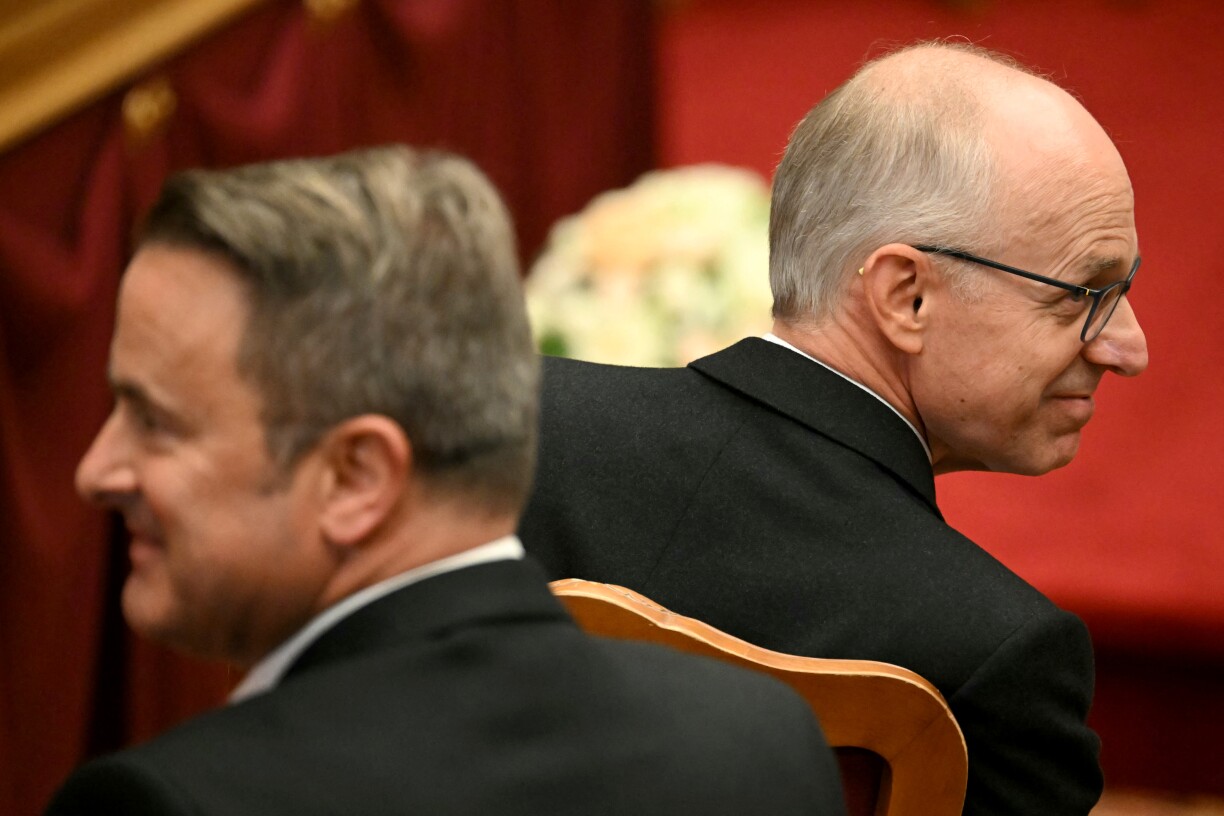
If elections were held this Sunday, a coalition between Luc Frieden's Christian Social People's Party (CSV) and Xavier Bettel's Democratic Party (DP) would no longer be possible due to the CSV's loss of parliamentary seats, according to a new "Sonndesfro" poll. A three-party coalition would become absolutely necessary. The survey, commissioned by RTL and Luxemburger Wort and conducted by Ilres, reshapes the distribution of political forces to an unusual degree and also reflects voters' opinions on current affairs.
The results come as little surprise, given the lack of understanding between workers and the CSV-DP government displayed at the start of the month, as well as the downward spiral of Prime Minister Luc Frieden – which worsened at the end of 2025 – and of his party over many months. The poll is devastating for the CSV, which has been by far the best-represented party in the Chamber of Deputies (21 out of 60 MPs) since the legislative elections of 8 October 2023.
If an election were held this Sunday, the CSV, headed by Luc Frieden, would suffer an electoral defeat that would go down in the annals of Luxembourgish politics. The current government coalition between the CSV and the DP would fail to secure a parliamentary majority.
At the mid-term point, this Sonndesfro poll weakens the electoral weight of the country's largest party like never before: the CSV would lose 8 points in one go, securing 21.8% of the vote compared with 29.8% in the last legislative elections two and a half years ago – a massive drop.
Other parties would benefit, starting with the coalition partner DP. Its current Minister for Foreign Affairs and former Prime Minister, Xavier Bettel, remains a leading figure on the political chessboard, ranking at the top of voters' favourite politicians as of December. With 21.5% of the vote, the DP would pull level with the CSV.
Hot on their heels, the Luxembourg Socialist Workers’ Party (LSAP), the main opposition party, would gain 2.7% to climb to 20.9% of the vote, making it the big winner. This would result in a rare levelling at the top of the political pyramid, as the CSV, DP, and LSAP would achieve almost identical scores.
While the Pirate Party would see a drop of 2.9%, three other parties would capitalise on the new distribution of votes. The Alternative Democratic Reform Party (ADR), thanks to a 1.8% increase, would cross the 10% threshold to reach 11.4%. The Green Party (Déi Gréng) would gain 1.2% to reach 9.5% of the vote, and the Left Party (Déi Lénk) would secure 5.8% (+2.2%).
If a vote were held this Sunday, the current coalition between the CSV and the DP would no longer be mathematically possible. The CSV would lose six seats in parliament, securing only 15 – a historic low, as the party has never had fewer than 21 MPs since the end of the Second World War (including currently and in 2013).
15 seats would put the CSV on par with the DP, which would gain one seat. The historic coalition between the CSV and the LSAP would not be possible either. Although the LSAP would gain three MPs, it would peak at 14 seats within the Chamber of Deputies.
"We would go from a comfortable majority of 35 seats (21 for the CSV and 14 for the DP) to a situation where, under no circumstances, would a two-party coalition be possible to secure even the slimmest majority," comments Thomas Crépon, Director General of Ilres.
In short, a three-party coalition would become a necessity to successfully form a government majority in Luxembourg. One option would be a return to the LSAP-DP-Greens coalition that was in power from 2013 to 2023. However, many other political combinations would also be possible on paper.
The new distribution of seats would split the Chamber of Deputies into four almost proportional quarters. One of these would group the 16 MPs from the ADR (7), the Green Party (6), the Left Party (2), and the Pirate Party (1) – the latter of which currently holds three seats in the Chamber.
Through this Sonndesfro poll, the trade unions see their protest actions validated. On Tuesday, the Independent Luxembourg Trade Union Confederation (OGBL) and the Luxembourg Confederation of Christian Trade Unions (LCGB) launched, as announced on 1 May, a new series of trade union actions outside the Ministry of Labour ahead of the Tripartite meeting. Some 66% of voters believe the unions are right to take action.
In the same response, two-thirds of voters denounce the government's policies as being too liberal.
However, voters are not entirely against employers: 56% of those polled fully understand employers defending themselves against unions that want to see the statutory minimum wage immediately increased by €300. Those surveyed believe that entrepreneurs cannot bear such a structural increase.
The poll reveals that the vast majority of voters are in favour of convening a tripartite meeting and believe that Luc Frieden's CSV-DP government should have called one much earlier. It should be noted that the poll was conducted before the Prime Minister's announcement to convene the social partners. The social climate in Luxembourg has been growing tense due to rising energy prices linked to the war in West Asia, discussions around the need to increase the minimum wage, and concerns over safeguarding the country's healthcare system. The tripartite meeting is therefore highly anticipated.
This Sonndesfro poll clearly confirms that housing is the number one political issue in Luxembourg. An overwhelming majority of respondents (88%) believe that excessively high rents make it impossible to live on the minimum wage.
Although tax reform is at the heart of the CSV-DP coalition agreement, the poll suggests that it should not really be a government priority. The issue is divisive: 44% of the electorate believes that the overall context – sluggish growth, rising unemployment, the war in West Asia, and high energy prices – is not conducive to carrying out a major tax reform that would cost the state nearly €1 billion a year.
Often called into question recently by US President Donald Trump, NATO remains a reliable defence organisation for Europe in the eyes of 56% of voters surveyed. They believe that in an emergency, NATO would enable the defence of the continent. Conversely, more than a third of voters no longer see things this way.
There is little doubt on the issue of banning social media for young people under the age of 16 in Luxembourg: 71% of voters surveyed are in favour.
This poll was conducted between 13 and 24 April 2026 by phone and online among 1,863 people of voting age. A total of 1,156 interviews were conducted by telephone (223 on landlines and 933 on mobile phones), and 707 interviews were conducted online.
Further details are available on the website of the Independent Luxembourg Broadcasting Authority, Alia.lu.





