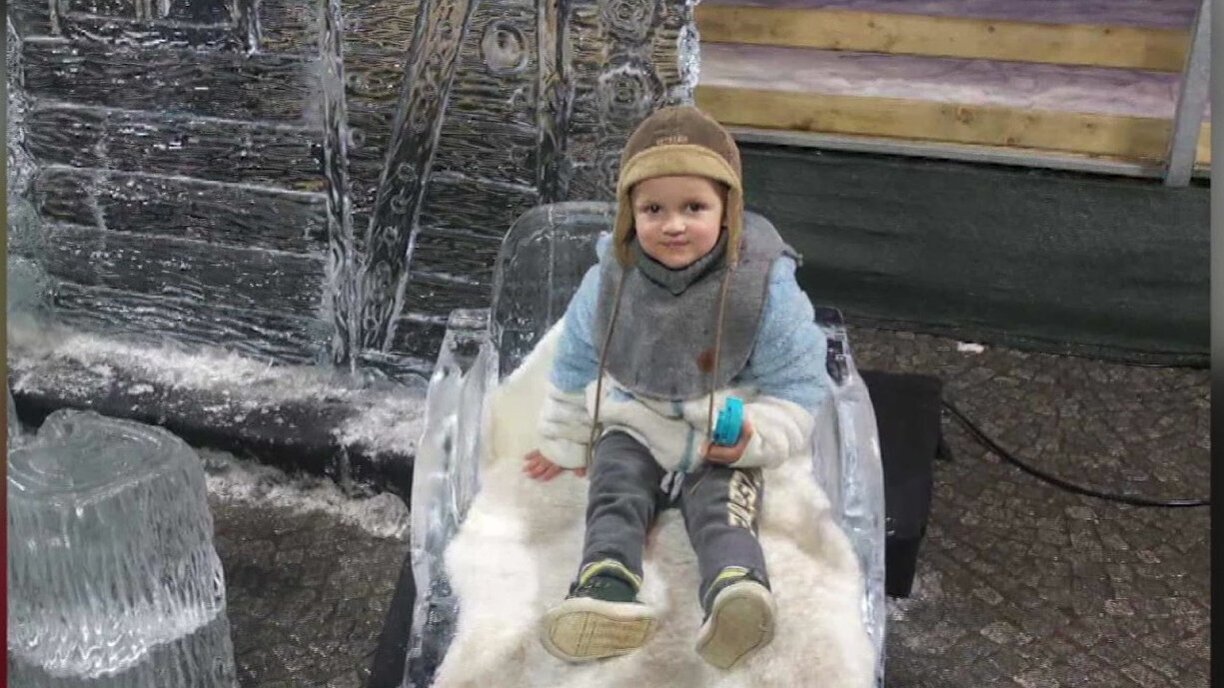
At the Luxembourg City court on Tuesday, the trial concerning the fatal accident involving the ice sculpture at the 2019 Christmas market continued with the hearings of the sculptors.
The lead sculptor, who was hired by the Luxembourg City Tourist Office (LCTO), insisted once again that he had drawn his contacts' attention to the danger of allowing people to pass behind the sculpture.
According to his lawyer, Philippe Stroesser, when the sculptors arrived at the site with their lorry in November 2019, they were offered an initial location – more central, between the walkway connecting Place d'Armes and Place Guillaume II on one side and the ice rink on the other. The lead sculptor immediately said that this would not work, Stroesser summarised.
At that point, the sculpture was moved closer to the ice rink. The sculptor was allegedly told that he would have to leave a gap of about 70 centimetres between the ice rink barrier and the sculpture. His lawyer noted that this location was still unsatisfactory, though better than the first. Stroesser stressed that his client also expressed reservations about the second location. "And that is when he was told: no, there is no room for discussion, it will be in that spot, and there is no possibility of negotiating the matter," the lawyer said.
The sculptor's two employees did not have a precise enough memory of the discussion to state with certainty on Tuesday whether it had indeed been about safety aspects or, as the defence for other accused parties stated in hearings on Monday and Tuesday, solely about visual and aesthetic considerations.
The sculptor's interlocutors from that time – namely the employees of the LCTO, who are also accused – have not yet testified. Their lawyer, Pol Urbany, disputes this version of events. He pointed out that the sculptor had not mentioned this in previous hearings either. Urbany characterised the claim as a "protective claim of the main defendants in the main trial" – a statement being made now to defend themselves and extricate themselves from the matter, which Urbany personally deems not credible.
For this reason, a witness who was present at the discussion is due to testify on Thursday. However, Urbany noted that the question of the location may not actually be relevant, because the expert reports indicated that the sculpture fell because it was not standing straight and not standing solidly. "And it was the sculptors' job to ensure that," Urbany said.
According to the expert reports, the accident can be traced back to a series of converging causes. These included the 2% gradient on Place Guillaume II, which should have been levelled out, as well as the positioning of the sculpture on the pallets. The sculpture was not fully supported lengthwise toward the ice rink, and its weight was not properly distributed. Added to this was the poor condition of the pallet, which reportedly wobbled even without a load.
On Monday, the representative of the public prosecutor's office asked the sculptor whether he had brought a mason's level with him, along with wedges to prop up the pallets on the slope. "No," was his answer. Neither he nor his employees had noticed a significant slope. The lead sculptor said that since the accident, he has always carried a mason's level, even though his clients would normally inform him if a slope were present.
The sculptor also apologised to the parents of Emran, the 2-year-old boy who was between the sculpture and the ice rink when the sculpture collapsed, and who did not survive the accident.
The trial continues on Wednesday.





