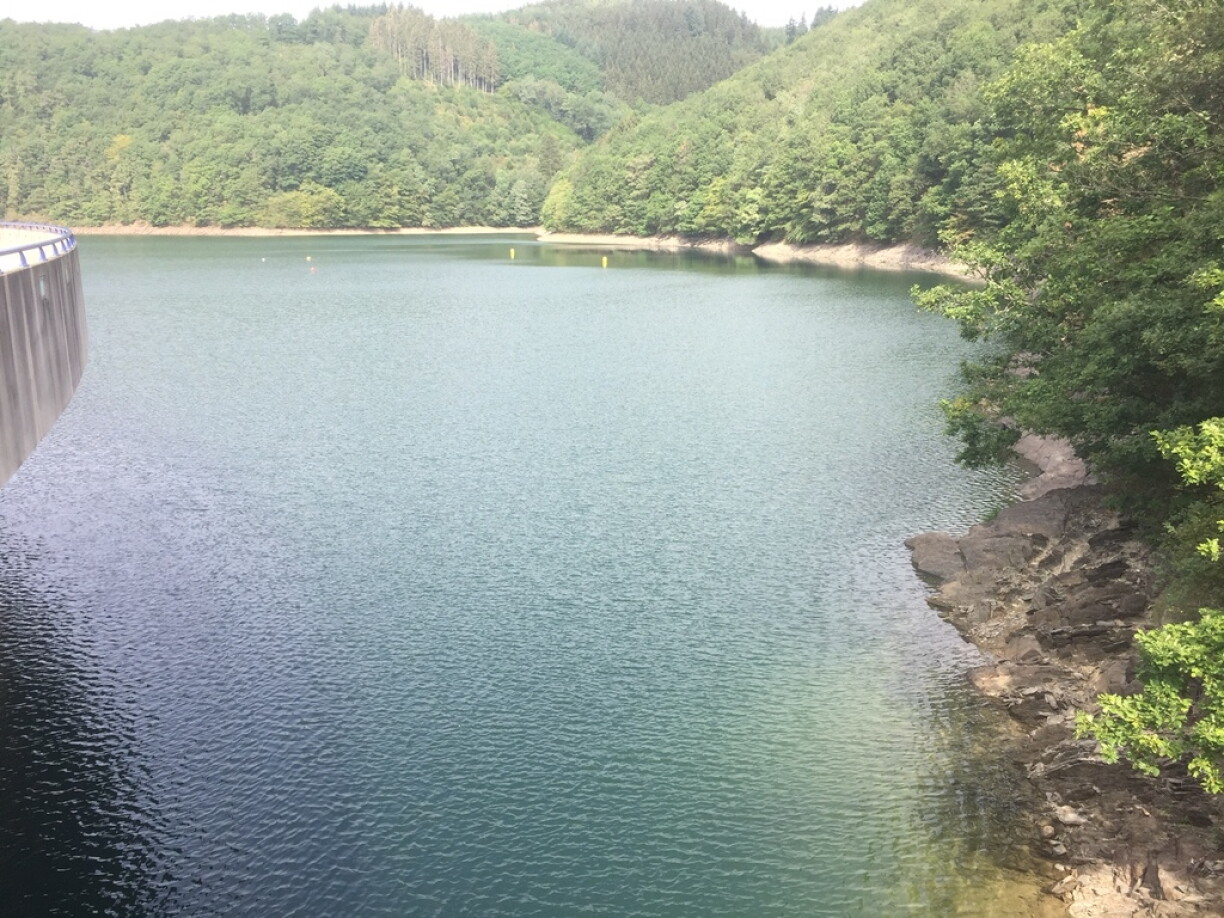
Summer 2019 has thus far proven to be extremely hot and dry, which begs the question of Luxembourg's water reserves and their current state.
The lake at Esch-sur-Sûre has a water level which is 80cm lower than last year, but is not yet causing alarm.
The lake is around 317 metres above sea level, with around 43 million cubic metres of water. There may be less water than in 2018, but the difference is not considered to be dramatic.
Should the lake fall below 310 metres above sea level, there would be veritable cause for concern. The assistant director of SEBES, Christian Schroeder, said there were currently no issues with the amount of water. Water is only drawn from areas where the quality is best, and SEBES carry out regular analysis to guarantee this.
Around 86% of Luxembourg's tap water is provided by SEBES. The water quality in summer is virtually identical to the quality in winter, but this is not the case for the quantity, said Jean-Paul Lickes, director of the Water Economics Office. He pointed out that there is a natural increase in demand for water during summer, but the "Congé collectif " helps to regulate the water usage in the hotter months.
In case of an emergency, SEBES is able to use reserve water springs. Luc Zwank, assistant director of the Water Economics Office, said that although in winter there is more rainfall, there isn't enough to make up for the amount of water polluted by nitrates or pesticides - enough water for 75,000 inhabitants has been rendered unusable by pollution, which places more important on SEBES' strategy for creating protected areas.
Since 2017, a new preparation plant has been constructed in Eschdorf, with a capacity to process 100,000 cubic metres of drinking water per day. The first part of the plant should open before summer 2021.