Smoke from the wildfires in the High Fens was clearly measurable in Luxembourg on Monday afternoon. The Environment Agency's Meng Loft app classified air quality as "very poor", while LU-Alert remained green, indicating no danger or health risk. So how can the two be reconciled?
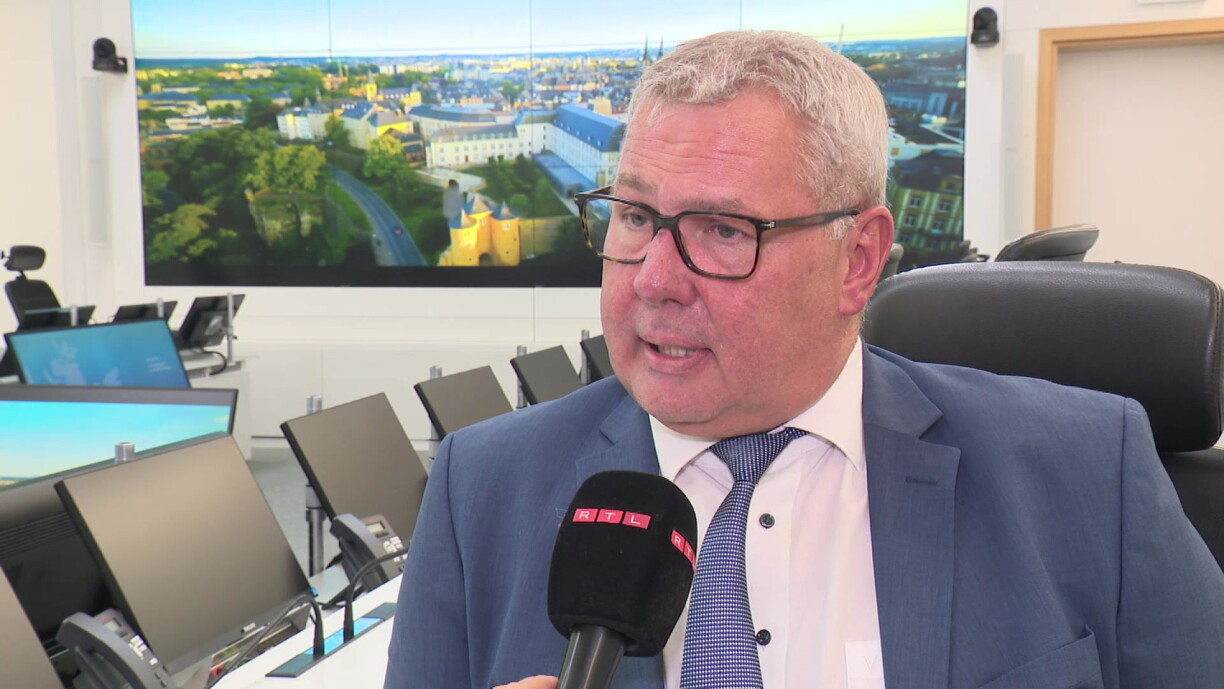
High Commissioner for National Protection Guy Bley stressed that he is neither a health nor an environmental expert, but said the authorities had started communicating at a very early stage, while air-quality readings were still normal and no particular risk had been identified.
"We communicated very early", he said, adding that information was already being issued "at a point when all the values were still completely normal". According to Bley, there has so far been no major risk to the population.
The "values" refer to air-quality measurements and the thresholds at which authorities are required to issue information. However, other factors are also taken into account, including calls to the 112 emergency number and whether there has been an increase in ambulance deployments or requests for doctors.
Bley said there had been no such increase on Sunday. Even though there was no indication of any particular problem at the time, the authorities nevertheless decided to act preventively, he said.
He explained that health officials and environmental experts were brought together to assess the situation and consider how it might develop over the following hours. "There was not yet any situation raising a specific concern", he said, but the authorities nevertheless wanted to "evaluate together what the situation meant and what could happen in the next few hours".
Based on that assessment, preventive recommendations were issued, he said.
The fact remains, however, that when the first LU-Alert text message was sent at around 3pm on Sunday, merely warning that people might notice an unusual smell, many residents had already been smelling the smoke for some time. Several municipalities had also already issued their own recommendations.


The Ministry of Home Affairs welcomed the fact that some municipalities had taken the initiative.
Alain Becker, head of civil security at the ministry, explained that local authorities are encouraged to develop resilience plans. The general approach, he said, is to provide information early while avoiding unnecessary panic.
This also means monitoring how neighbouring countries respond, particularly when incidents occur outside Luxembourg.
Becker said the 112 emergency services had followed communications issued by authorities in Rhineland-Palatinate, North Rhine-Westphalia, and Saarland. The information provided across the regions was "not always the same and was sometimes even contradictory", he said, meaning Luxembourg also had to consider carefully what message to pass on to the public.
The LU-Alert concerning the smell was sent by the Grand Ducal Fire and Rescue Corps (CGDIS), which in this case based its approach on that taken by the French authorities.
A second LU-Alert message was sent at 7.30pm, advising people to close their windows because of the smoke and directing them to the website for further information. By then, smoke had already spread across much of the country.
Asked whether the authorities could have communicated earlier, Bley said the situation in the High Fens, including wind conditions, had been monitored since Saturday in cooperation with Meteolux and the CGDIS.
Conditions, however, varied considerably from one municipality to another. "The situation was slightly different in every village", he said, adding that the challenge was to issue information that would be accurate for the entire country.
Bley also argued that a localised cell broadcast warning would not have been appropriate in this case.
The system, he explained, is intended for situations requiring an immediate and highly urgent reaction from people in a very specific area. With smoke moving across the entire country, it was impossible to determine exactly where it was present at any given moment.
The situation continues to be monitored, according to Bley. Once the immediate response is over, the authorities plan to evaluate how communication could be improved in future.





