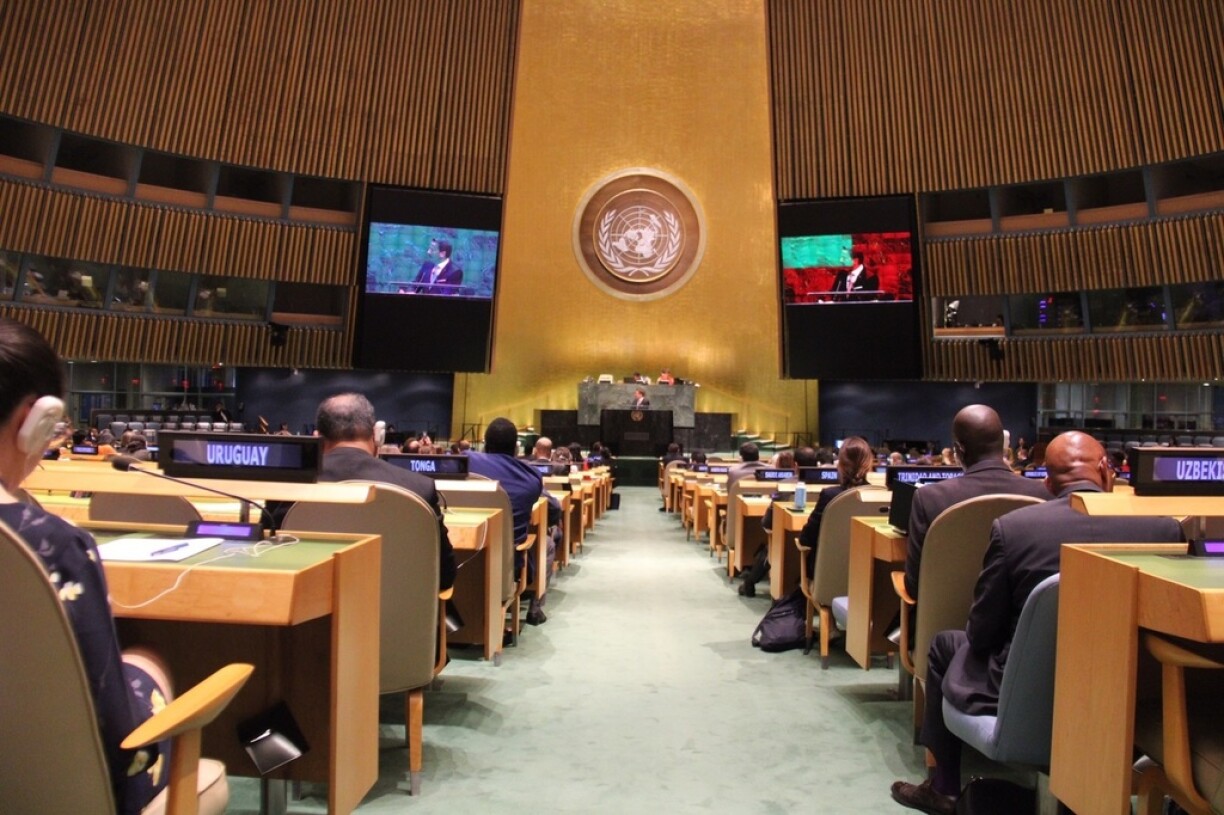
On 26 September 2019, Prime Minister Xavier Bettel delivered a speech at the general debate of the 74th United Nations General Assembly. In his speech, Bettel noted that the assembly fell in a remarkable week in many respects, not only due to the topics discussed, but also the unprecedented mobilisation against some very concrete challenges.
Climate change
The first point he addressed in his speech was the mobilisation of young people against the climate crisis. Climate change has worsened from year to year, with the effects visible in a number of everyday areas. Luxembourg has set a goal of reducing emissions by 50-55% by 2030, and increase the amount of renewable energy by 25% in the same timeframe. However, Bettel said this alone was not sufficient.
Numbers are one thing, but the frustration among young people is that numbers will remain empty, just for show. He said it was up to his generation to show their children that their future is secure. The hope and optimism of emerging generations will feed on the confidence inspired by the actions of their parents. Bettel insisted young people were his allies in the fight against climate change, saying youth embodies change.
As a step towards reducing emissions, the Grand Duchy decided to make public transport free for all to use. It will also invest 1% of its GDP in supporting developing countries against climate change, as well as doubling the contributions of previous years to help other nations with low greenhouse gas emissions. Bettel underlined the importance of not making empty promises to the international community of young people demonstrating against climate change.
Middle East and Africa
The Prime Minister noted the importance of avoiding making the same mistakes from recent decades in the Middle East. The EU is ready to step in to prevent the situation between the USA and Iran from worsening, with the aim of cooling off tensions. Bettel also touched on the situation in many African states, citing the importance of helping the situation to improve in terms of living so that thousands of migrants no longer need to risk their lives to come to Europe.
Tackling extremism
Bettel then wondered if mankind had learned anything after the Second World War. Visiting concentration camps such as Auschwitz provided insights into what the Nazis did to people who were considered to follow the "wrong" religion, people with disabilities, homosexuals, or simply people who opposed their regime. He deplored the fact that such ideas and ideologies appear to be gaining momentum across the globe once more.
As stated in his speech earlier this week, homosexuality is not a choice, Bettel reiterated, although homophobia is a choice one has to make. He stated this should not be tolerated by any government.
Equality for women across the globe
The Luxembourg PM said it was not the role of men or governments, to tell women what they can and cannot do. In Luxembourg, abortion laws were amended so women were able to make decisions for themselves, without requiring extensive processes beforehand. He reiterated the importance for women to lead their lives without restrictions.
A lot of work remains to be done on the issue of human rights in general, said the Prime Minister. According to him, Luxembourg's commitment to the promotion of human rights is part of its DNA, and for this reason the Grand Duchy has applied to be elected Human Rights Council for the period 2022-2024, for the first time since the establishment of the Council.
In conclusion, Xavier Bettel said the UN is an important institution to help build a unified future. To achieve this, he felt it was time to stop speaking over one another, and to discuss together.
Xavier Bettel joined the Luxembourg community in New York on Wednesday as part of the trip to the UN. The premier said Luxembourg citizens abroad were the best ambassadors for the country, while at a reception at the Maison du Luxembourg in the Big Apple.
Over the last few days, the Prime Minister also seized the opportunity to hold a series of bilateral meetings to take stock of bilateral relations and address major international issues, notably with Mr Vinicio Cerezo, Secretary General SICA (Central American Integration System), Mr. Xavier Espot Zamora, Head of Government of the Principality of Andorra, Mr. Kassym-Jomaret Tokayev, President of Kazakhstan and Mr. Paul Kagame, President of the Republic of Rwanda.


Minister for Foreign Affairs Jean Asselborn has also been in New York for the last two days, participating in the 74th session of the United Nations General Assembly, as well as a number of bilateral discussions, involving Palestinian president Mahmoud Abbas among others. Minister Asselborn discussed with President Abbas, in the light of recent elections in Israel, the main elements that could help revive the talks between Israel and Palestine. They agreed that the formation of a new Israeli government headed by a new prime minister could provide a glimmer of hope for the Palestinian people.
On Wednesday, 25 September, the Luxembourg Foreign Minister participated in the conference supporting the entry into force of the Comprehensive Nuclear-Test-Ban Treaty (CTBT)
The topic of refugees was also discussed among diplomats. Also on 25 September, Asselborn conducted a discussion with the general director of the International Organisation for Migration, Antonio Vitorino. The cooperation between the organisation and the Grand Duchy was noted.
Jean Asselborn also gave the opening address at an event organized by Luxembourg with the IOM, Mexico and Colombia to promote migrants' access to health services. The head of Luxembourgish diplomacy said an intersectoral approach was essential to optimise access to health systems, adding that social protection and access to affordable care were fundamental aspects of migrants' health regardless of their legal status. On his travels in Africa, the Middle East and the gateway to Europe, Asselborn said he had been exposed to the multiple traumas suffered by refugees and reiterated the importance of offering care for their physical and mental well-being. In doing so, he said this would facilitate their social and economic integration through the establishment of protective systems, thus honouring human rights.