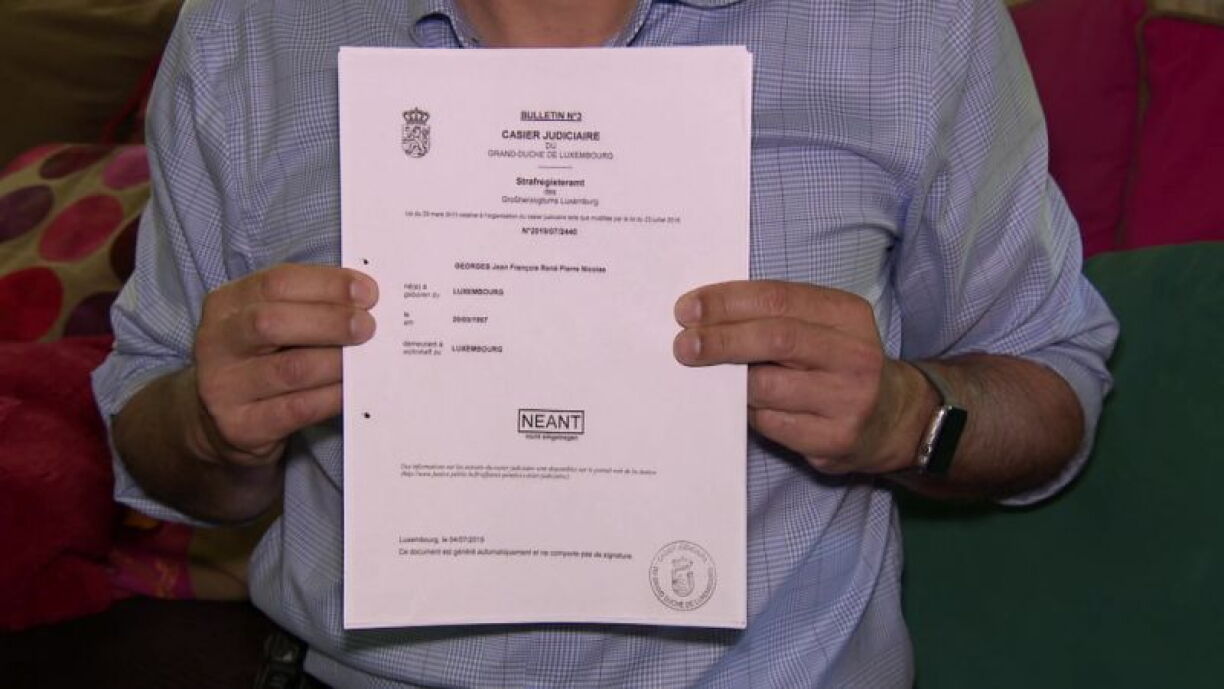
Those who were not allowed to participate in the official National Day ceremony are ensuring that enquiries are still being made. And, bit by bit, explanations are surfacing. RTL originally drew attention to this state of affairs with the François Georges report.
"Threat to national security" despite clean criminal record? Is Luxembourg keeping secret records on its citizens?Prime Minister and Minister of State Xavier Bettel, Minister for Internal Security Francois Bausch, and Minister of Foreign and European Affairs Jean Asselborn provided a joint response to a parliamentary question issued by CSV MPs Gilles Roth and Laurent Mosar, who had demanded clarity on the issue.
The ministers confirmed that indeed, any and every person wishing to participate in the ceremony held at the Philharmonie must undergo an evaluation to determine their suitability.
In light of the revelations the opposition had a number of question as regards the police’s central database and the “Ju-Cha” system. MPs submitted an urgent parliamentary question on 22 July, but it was deemed not urgent. In any case, the three ministers responsible – the Minister of Foreign Affairs, the Minister of State, and the Minister for Internal Security – had the following response.
The evaluation process is based on a 2018 law concerning the exchange of private data. According to Bettel, Asselborn and Bausch, only people who were already in the police’s central system was passed on to the government, albeit unofficially.
The ministers provided a copy of a police email where a number of statements relating to different individuals were discussed – individuals who were already in the system and were thus advised to be either in- or excluded from the ceremonial procedures. The language in the police email is extremely casual and informal.


The ministers admitted fault in the way things had been done, and that in future, procedures would not only be more official, but they would also determine the specific criteria that would give grounds for exclusion.
It seemed that until then, the police had handled the whole process in a rather laid back manner. The ministers emphasised that only people who had had run-ins with the law – aside from traffic regulation violations – were affected. They would also attempt to introduce the possibility of an appeal to rejections, which is currently not possible.
Officially-invited guests were not screened.