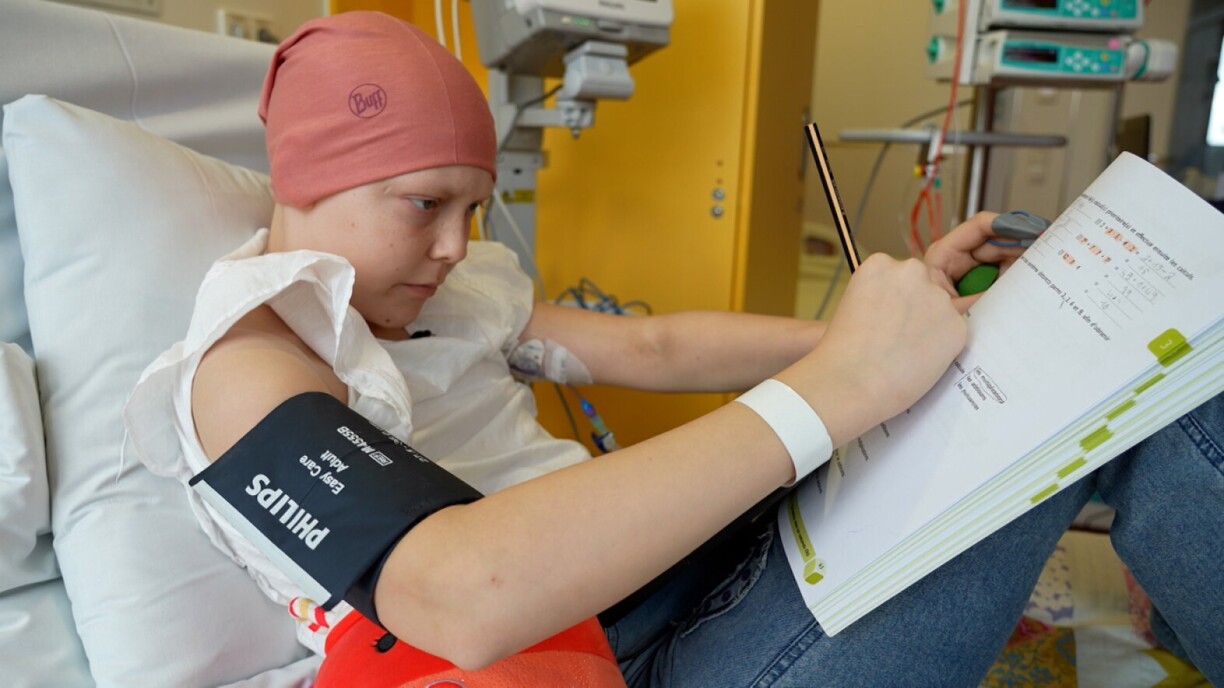
The Ministry of Education's support group for pupils in hospital or in remission (CA(H)RE) has 30 staff members who assist students with severe illnesses throughout their educational journey.
In July 2025, 12-year-old Constance was diagnosed with Hodgkin lymphoma. She traded her classroom for a hospital ward and missed the start of her first year at secondary school.
For students like Constance, who underwent six months of chemotherapy, several support measures are available through CA(H)RE. The service was established by the Ministry of Education in September 2024, with most of its staff being teachers and educational and psycho-social support workers.
Once a family receives a diagnosis, the student can choose to be supported by a teacher who provides lessons either at home or in the hospital. In more severe cases, such as Constance's, an avatar option is available: a small white “robot” with a camera that allows the student to watch lessons on an iPad.
"I can see the teachers and my classmates, but they can't see me", says Constance, "because there are days when I don't feel well or don't look my best".


CA(H)RE supports an average of 25 to 32 students per year, from primary through to secondary school. These are children and young people with oncological or haematological diseases, or those who have undergone organ transplants followed by immunosuppression.
"It is important that the young person is not forgotten, both as a student and as a person, by their classmates and teachers, and that they maintain their role as a student", said Tim Rinnen, head of CA(H)RE.
The service organises at least two awareness sessions in the student's class: one when the student leaves school, and another upon their return.
"We go into the classroom to answer questions about the illness and about the student, depending on what they wish to share or keep private," said Anna Feiereisen from CA(H)RE.
"It's important that the illness isn't a taboo for the students, and that they don't feel alone with their fears and questions. We exist to guide them," she explained.
Beyond these situations, CA(H)RE also works with children and young people hospitalised in open or closed psychiatric units, internal medicine wards, or physical rehabilitation units. In such cases, teaching staff are deployed on-site at the hospital in specially equipped classrooms.