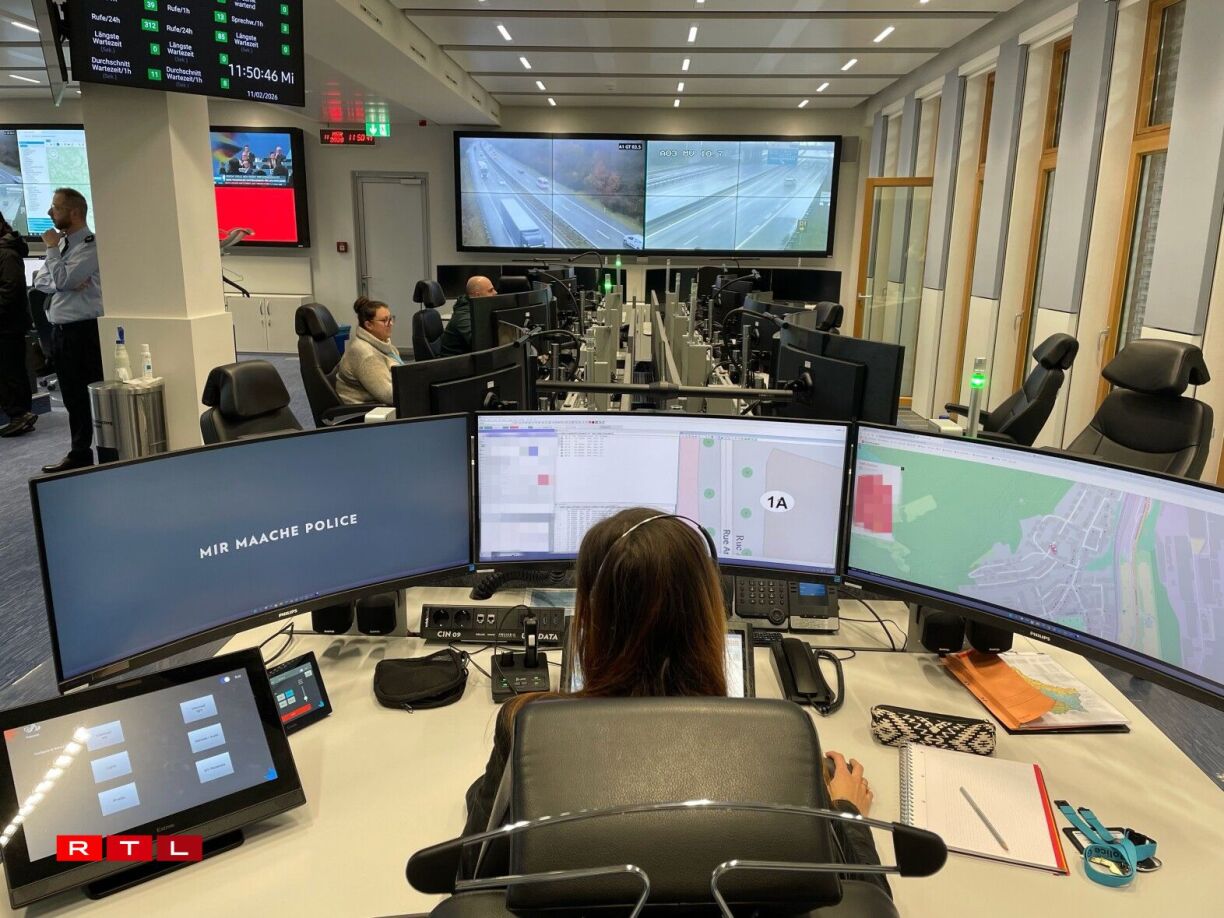
Luxembourg police have brought their upgraded National Emergency Despatch Centre into service at Findel, modernising how calls to 113 are handled and coordinated nationwide. The revamped centre has been operational since mid-November 2025 and features new command facilities, clearer separation between civilian call takers and police decision-makers, upgraded video and mapping tools, and an adjacent modernised Operational Command Post (PCO) for managing major incidents.
Authorities say the €5.5 million investment responds to growing operational demands and outdated infrastructure at the previous set-up, which had been in use for around 14 years.
In 2024 alone, police recorded around 139,000 calls to 113, an average of 380 per day. Calls range from minor public order issues, such as illegally parked cars, to life-threatening emergencies.
The first voice callers hear is that of a civilian call taker. Since November 2025, these operators have been working from newly equipped premises within the same Findel police complex, but in redesigned, more modern spaces.
Every detail provided by callers is entered directly into the intervention management system and transmitted in real time to the relevant police units. In the same operations room, a supervising officer coordinates deployments and, depending on the seriousness of the case, may take immediate operational control.
One operations manager explained that much depends on how critical reported situations are: "Some shifts can be calm, others can be more exciting – you always have to stay flexible."


For large-scale or complex situations, a decision can be made to activate the PCO, the dedicated command post located next to the call centre. There, specialised police units and external partners, such as the Grand Ducal Fire and Rescue Corps (CGDIS), coordinate strategy and resources around a shared table.
The importance of rapid response mechanisms was underscored during a recent fatal stabbing in Lampertsbierg. In that case, authorities quickly activated the PCO and deployed specialised resources.
Despite technological upgrades, officials stress that the system still depends on the people answering the phones, with call takers handling emotionally charged situations daily. Some leave a lasting impression, including those involving language barriers.
In one case, an operator recalled speaking to a distressed woman who spoke only Arabic and was crying, making communication extremely difficult. Nevertheless, rising to the challenge remains a top priority, according to the call taker: "We are the first point of contact with the public. In a way, it all starts with us. And that's a good feeling.”





