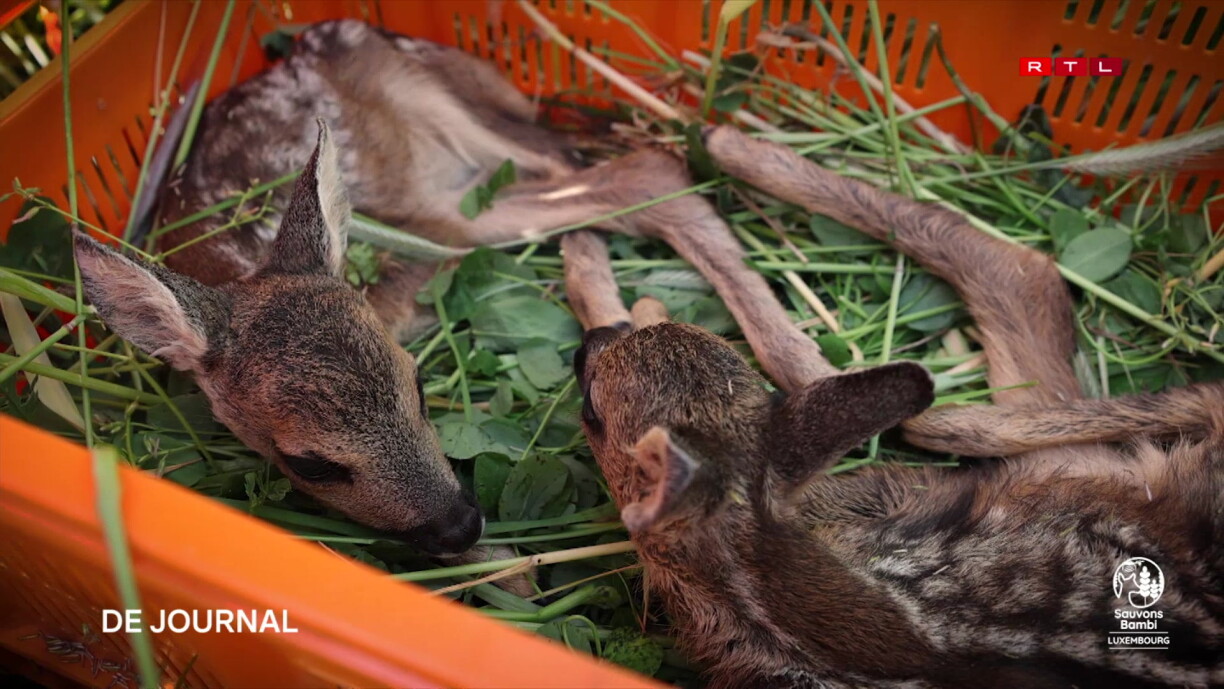
This year, around 350 fawns have been rescued before farmers started mowing their fields and meadows. That would not have been possible without the help of volunteers and the farmers themselves.
The non-profit Sauvons Bambi has been active for years, with hunters also lending a hand to bring fawns to safety from agricultural machinery. When animals are caught in such equipment, they die in a particularly grim way. Often they do not die on the spot but lie there for hours afterwards, suffering serious injuries.
Preventing that is not just in the animal's interest but also in the farmer's. If the carcasses go undetected and end up in the harvested feed, toxic gases can be produced, which can then make the farmer's livestock ill. That risk can, however, be avoided if farmers give notice before they start mowing. The Bambimap.lu application is designed to connect farmers and rescue teams.
Jacques Schroeder of Sauvons Bambi explained that things are relatively straightforward in Luxembourg: "Every plot is identified by a code. When the necessary information comes in, it is entered into the system, and from that point any pilot can log into the app, see what missions are open and sign up for them." Schroeder is talking about drone pilots, since it is drones that help spot small animals in the tall grass.


The new technical options are aimed above all at farmers and hunters, though of course anyone can get in touch, according to the president of Sauvons Bambi. Often, it is only thanks to the alertness of members of the public that animals can be helped.
Schroeder recalled a case a few weeks ago when the non-profit was told that a deer had been run over, which had milk in its udders. In such moments, teams move out and comb the surrounding fields for the young. This year, he added, they had found two fawns in that way who otherwise would have been left to their own devices.
Anyone who does come across a fawn, or indeed any other wild animal, should not touch it, Schroeder cautioned. The mother is often simply out looking for food, but if the young have been handled by a person, there is a real risk that she will no longer accept them, and the losses will pile up.
Some voices are calling for it to be made mandatory for farmers to declare their fields before mowing. In the eyes of Agriculture Minister Martine Hansen, however, that is not currently realistic.
"The resources simply are not there at the moment", Hansen said, "and there are not enough drone pilots either." What matters, in her view, is what has already been achieved, namely bringing the various stakeholders together, so that no one is any longer working in their own corner.
Hunters have already covered 14,000 hectares of land this year, with Sauvons Bambi accounting for 5,000 to 6,000 hectares. Hansen said the aim would be to keep expanding those figures, since the long-term goal is for every group to be able to look after its own area.