
The University of Luxembourg has issued a response following the publication of an article last Friday concerning alleged lack of transparency and conflicts of interest at the Institute for Advanced Studies (IAS).
The article focused on the allocation of Audacity research (supports bold, interdisciplinary, and high-risk scientific projects, and the development/use of the open-source audio software) funding last year. In 2025, the IAS awarded funding to a candidate who also sat on the jury responsible for assessing and ranking projects for those same grants.
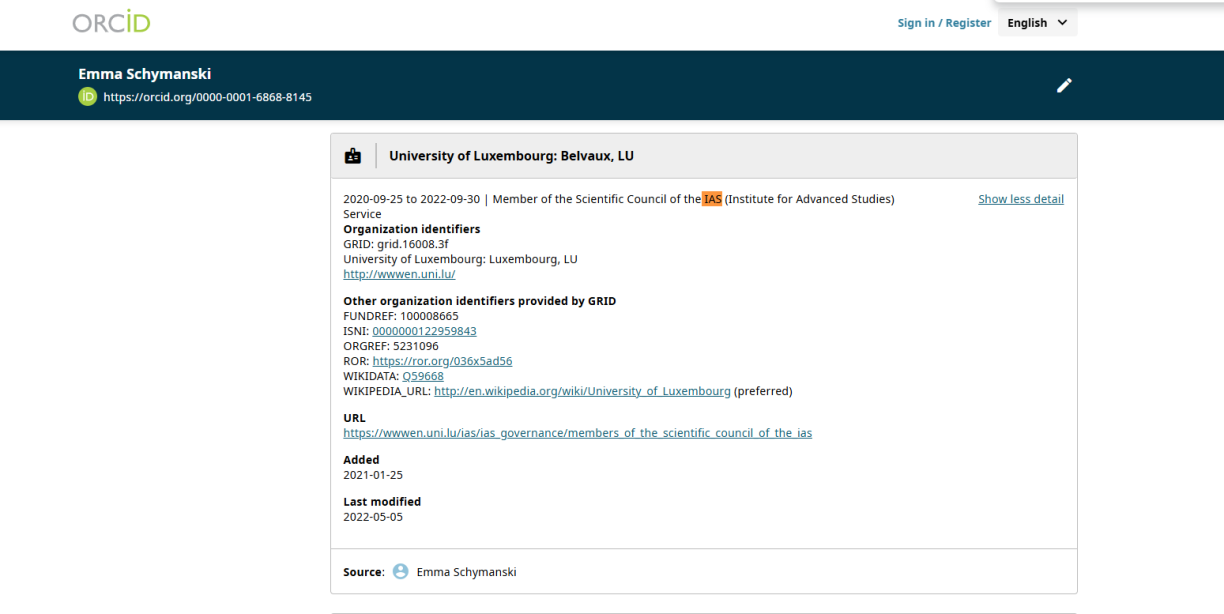
RTL reported that researcher Emma Schymanski, as a member of the IAS Scientific Council, the body acting as the jury, had evaluated and discussed competing projects. RTL also pointed out that, according to her CV, Schymanski had already served a term on the Scientific Council from 2020 to 2022, even though IAS rules state that such a mandate is limited to two years and is not renewable. Neither the researcher nor the university's press office responded to RTL's questions prior to publication.
Following the report, the university has now partially addressed the issue in writing. In its response, the press office wrote:
"Dear Mrs Sinner,
We read your story about IAS funds being rewarded to Prof. Schymanski last Friday and would like to provide some additional information after our initial response. The conclusions you draw in your piece are wrong, as they are based on several factual inaccuracies in your reporting. We ask that you urgently correct these points.
In your introduction, you say 'granted research funding to a candidate who also participated in the selection panel responsible for allocating the funds'. This is incorrect. Prof. Schymanski was part of the jury, but recused herself every time her own project came up, nor did she have any knowledge of the discussions that led to the selection of her project. This needs correction."
RTL maintains that its reporting was accurate. It did not claim that Schymanski evaluated her own project. Rather, the issue raised concerned her participation in evaluating competing applications while simultaneously being an applicant herself for Audacity research funding.
RTL had asked both Schymanski and the university in advance whether this constituted a conflict of interest under the Code of Conduct. These questions went unanswered. With its subsequent explanations, the university effectively confirms that Emma Schymanski was present when competing projects were discussed and evaluated.
The press office wrote further:
"In paragraph six, you quote our Code of Conduct, saying: 'Members of the University's bodies and committees shall refrain from taking part in any discussion or decision concerning matters where there is a conflict of interest on their part.' This is an incomplete quote of section 2.1.5. The sentence that follows the one you quote is: 'They should leave the meeting while the issue is being considered and should in no way look to influence discussions or decisions on such issues.' Prof Schymanski followed these instructions to the letter, as did everybody else involved."
The university further cited its Code of Conduct, arguing that RTL had quoted an incomplete section. However, the press office referred to an older version of the Code. In the current version, adopted in July 2025, the relevant provision states that: "University Members of the University's bodies and committees shall refrain from taking part in any discussion or decision concerning matters where there is a conflict of interest on their part."
It further specifies that: "This obligation applies in particular when the persons concerned exercise several roles, the combined exercise of which necessarily leads to a situation of conflict of interest, for example, when a person involved in a research project is also a member of the body supposed to evaluate the results of that research."
RTL notes that this wording does not alter the core issue: Schymanski remained present during discussions of competing projects and participated in the evaluation process, even if she withdrew when her own application was examined. Before publication, RTL had asked both Emma Schymanski and the university's press office whether they considered this situation to constitute a breach of the Code of Conduct. That question, like the others, went unanswered.
The university also disputed RTL's description of IAS governance procedures, asserting that: "In the two paragraphs about governance of the IAS, which you can find online, your account of the procedures is incorrect. In contrast to what you suggest, Prof Schymanski has always acted exactly in line with these procedures. Both of the above mentioned elements should be reflected in the story."
However, no additional evidence or alternative procedural references were provided to support that claim.
IAS governance procedures clearly state that mandates for internal university members of the Scientific Council are limited to two years and are not renewable: "Members of the College of IAS fellows who are UL-staff are eligible for nomination as elected representatives of the College of IAS Fellows in the Scientific Council. The mandate of member of the scientific council can exceed the duration of their Audacity project, but is limited to two (2) years, not renewable."
According to her CV, Schymanski served from September 2020 to September 2022, which would suggest she was no longer eligible to sit on the Council after that period. The university's response did not address this apparent contradiction.
The press office wrote further:
"The headline of your story says: 'Lack of transparency and conflict of interest in allocation of research funding'. Firstly, yes, there was a conflict of interest, as is often the case in academic procedures. Most are harmless administrative oversights, but we nevertheless have strict procedures to deal with them. In this case, the conflict of interest was recognised from the start of the procedure, and University staff dealt with it adequately. Rather than framing this as a negative, it shows our procedures work.
Finally, I’m wondering what makes you say that the process was intransparent? It was painstakingly recorded in our files, which allows us to say with confidence that the way the funds were granted to Prof Schymanski was entirely above water."
RTL disputes this assessment. If procedures had been properly applied, Schymanski would not have continued to serve on the Scientific Council beyond her initial mandate. Furthermore, RTL considers that the conflict of interest was not sufficiently mitigated, given that she evaluated direct competitors for limited funding while being an applicant herself. Those competing applicants did not sit on the jury evaluating her project. In light of these circumstances, RTL concludes that the allocation process lacked transparency.
The university's press office also pointed out that:
"You spell Prof. Schymanski’s name wrong in paragraph 8: 'Emma Schminansky'. As a public institution, the University endeavours to provide a great degree of transparency to the general public, and recognises the crucial role of the media in that conversation. In return, we expect the highest professional standards from journalists we engage with. I trust that you will take the above points in serious consideration."
RTL has promptly corrected this spelling error.
Most importantly, however, several questions posed by RTL remain unanswered, including whether Schymanski had a conflict of interest in the allocation of the 2025 Audacity research grants, and how that conflict, arising from her dual role as both applicant for funding and member of the decision-making body, was addressed; at which stages of the evaluation process she took part, both in relation to her own project and to the competing projects; how much funding was awarded to her project; how many competing applications were involved; and whether receiving funding from a body on which she sits complies with the university's Code of Conduct.





