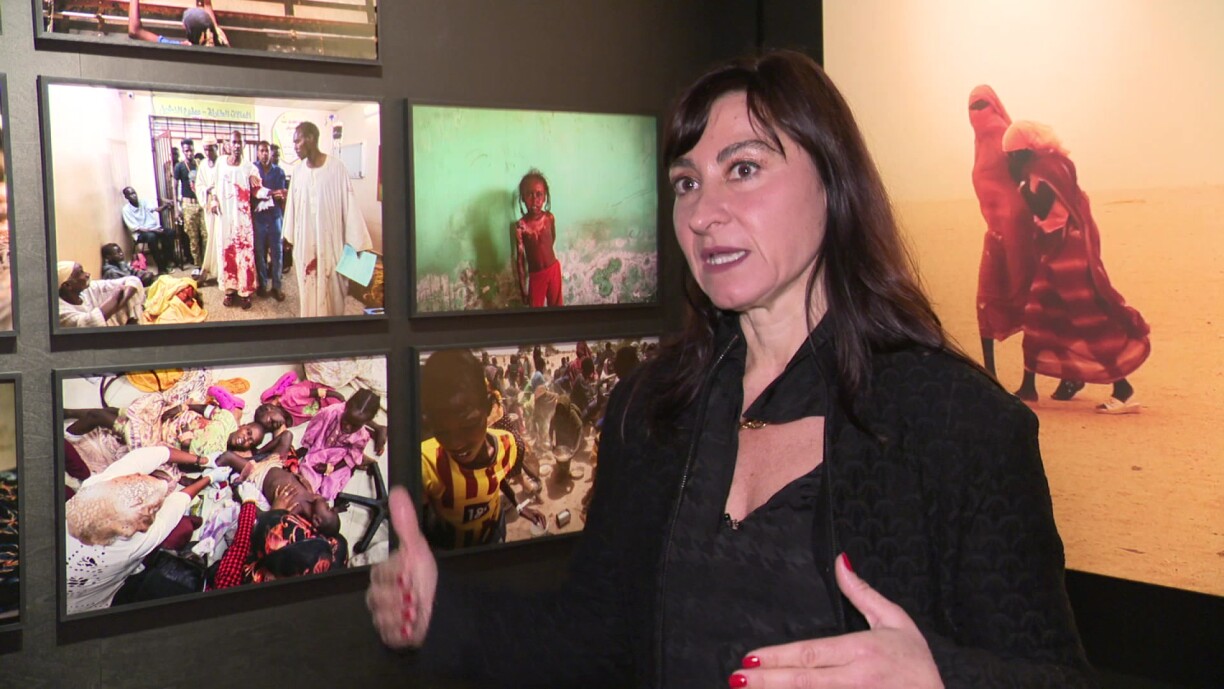
Afghanistan, Iraq, Sudan, the Democratic Republic of the Congo, the Middle East, and Ukraine. Lynsey Addario has spent over two decades photographing conflict.
Her work offers a deliberately different perspective on war, one she believes is too often portrayed in a one-sided way. Working in a profession dominated by men, she argues that certain stories simply go untold, particularly the experiences of women. While war photography tends to gravitate towards dramatic images of fighting, fire and devastation, Addario is equally committed to documenting the lives of civilians, and especially of women and children, who are, in her view, almost always the innocent bystanders.
Documenting the war in such a personal way and getting so close to people in extremely vulnerable situations inevitably raises difficult, ethical concerns about how far a photographer can go. Addario is acutely aware of this tension. When arriving at a scene of devastation, such as the Ukrainian family killed on a bridge, her priority is to capture the moment in a way that preserves the dignity of those involved. She is deliberate about avoiding gratuitous or graphic images, not least because she is always conscious that the families of victims may one day see them.
The public, she acknowledges, is becoming increasingly desensitised. Images of war, violence, and death saturate the media, from films and video games to social media feeds. For Addario, this makes the work of war photographers and correspondents all the more vital. Her goal is not to shock audiences, but to allow viewers to connect and identify with the people caught up in conflict. She wants to impart audiences with an understanding of just how far war seeps into every aspect of human life. She looks for stories behind the fighting, such as the mortality of mothers, women dying in childbirth because war has stripped away basic medical care.
The price paid by those who tell these stories has risen sharply in recent years. Addario points out that journalists are increasingly becoming targets themselves, with more than 200 killed in the Gaza Strip alone. As the danger grows, she warns, media organisations are sending fewer people into the field, unwilling to bear responsibility for their deaths.
After more than two decades in war zones, one thing continues to strike Addario: the extraordinary resilience of women. Many have lost their children, their partners and their homes, yet they display remarkable strength, courage and a will to keep moving forward.
The "Women in War" exhibition runs until 20th December at the National Museum of Resistance and Human Rights in Esch-sur-Alzette.