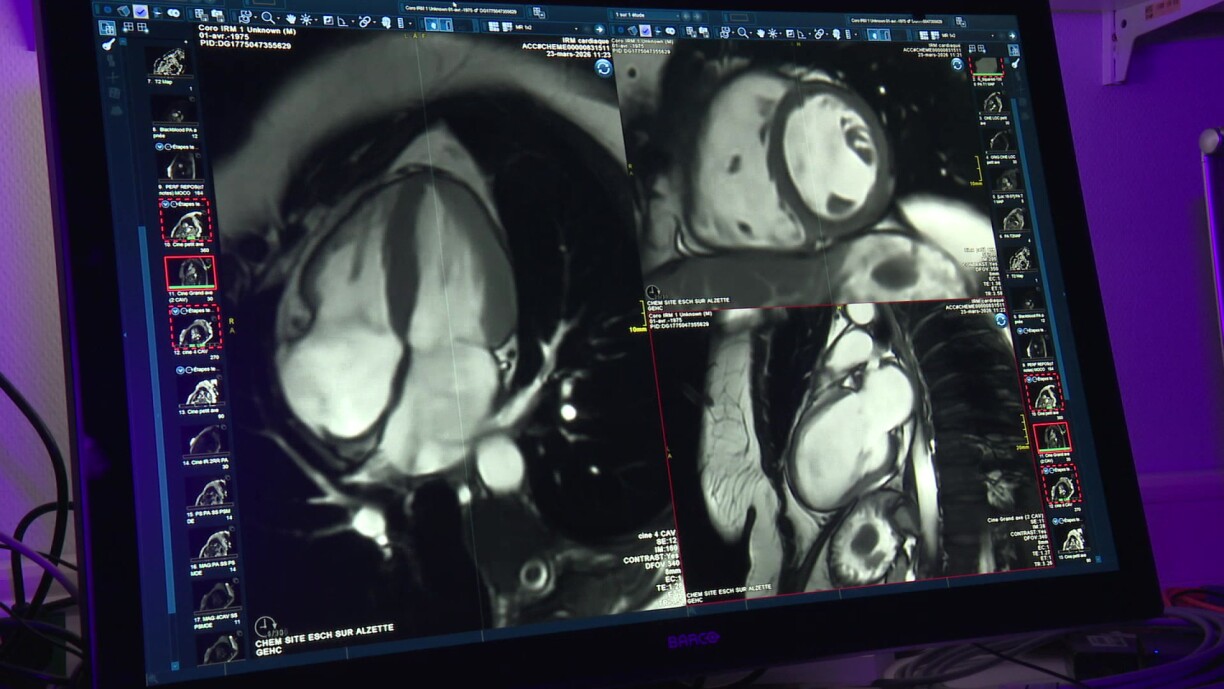
The Hospital Centre Emile Mayrisch (CHEM) has now become the first hospital in Luxembourg and the Greater Region to be certified as a reference centre by the German Radiological Society (DRG), as the quality, safety, and medical expertise of its cardiac imaging meet the highest standards.
According to radiologist Dr Georges Weyrich, the certification is both a recognition and a strong signal externally: a quality label that reflects the close collaboration of all CHEM staff, as well as the high standard of cardiac imaging carried out using CT scans and MRI. It is, above all, important for patients, he said.
Dr Weyrich stressed that patients remain at the centre of care and that they can be confident that their heart scans, whether via CT or MRI, are performed to a very high standard. He added that being subject to external comparison and review is crucial, as it ensures greater transparency and guarantees consistently high-quality results.
He explained further that the aim is to deliver precise, fast, and reliable outcomes, allowing patients to trust both the examinations and the medical teams.
The certification is not a one-off snapshot, as the work and performance of the team are monitored over time. It is valid for five years, with ongoing checks in between, and results must be demonstrated again after a certain period, according to Dr Weyrich.
He explained that this involves assessing how doctors have continued their training and how many examinations they have carried out, adding that the DRG also conducts anonymised spot checks.
Dr Weyrich stressed that re-certification is just as important as the initial certification, as it helps maintain team motivation and ensures that the same high standards are consistently upheld.
In addition, the CHEM obtained an overall quality label several years ago. The aim is to move towards a new hospital model in which quality is measurable, guaranteed, and maintained at a high level, according to Dr Weyrich.
Radiology must therefore continue to evolve, he said. As part of this process, the department has been using artificial intelligence to further enhance image quality for several years now.
Prevention remains key, particularly for at-risk patients, for example those with high blood pressure, high cholesterol, or who smoke regularly. CT scans and MRI are two complementary medical techniques that provide different perspectives on the heart.
Valentin Vanvinckenroye, head of Radiology at the CHEM, explained that CT scans are used to examine the arteries, identifying narrowing or blockages that may require further, potentially invasive treatment.
MRI, on the other hand, focuses on the heart's function and the condition of the heart muscle, making it possible to detect issues such as myocarditis, which cannot be seen on a CT scan, according to Vanvinckenroye.
Last year, around 2,500 patients underwent CT scans and 300 had MRI examinations. The choice depends on what needs to be assessed, with CT scans generally taking less time than MRI.





