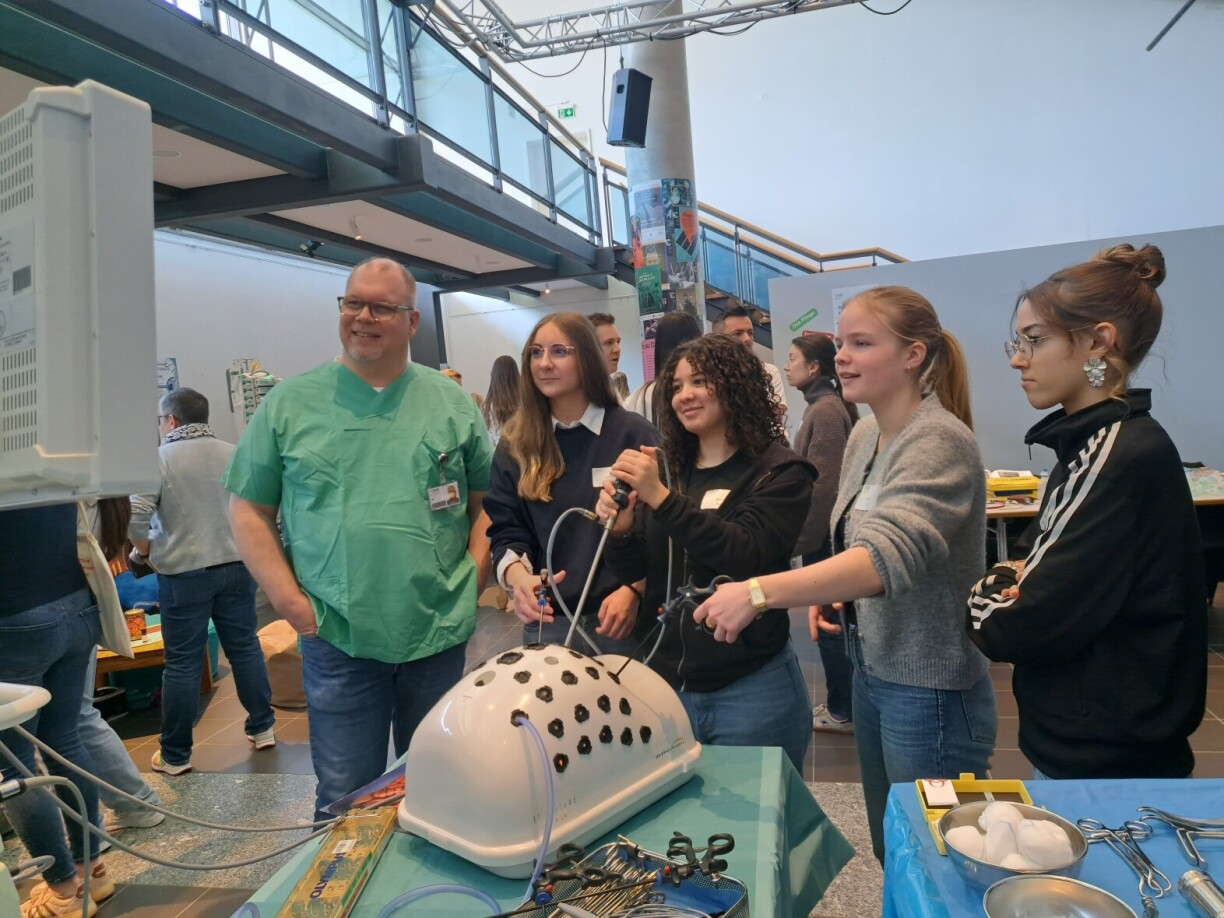
A hospital relies on far more than the medical professions most people immediately think of, such as nurses, midwives, or anaesthetists, with lawyers, economists, and electricians also needed in a hospital every day.
To show young people from secondary schools in the north of the country this wide range of professions, the Northern Hospital Centre in Ettelbruck (CHDN) organised a large Careers Day for the first time.
Electricians, gardeners and even painters are all part of the technical service. These are jobs people might not immediately associate with a hospital, yet the technical service plays a major role in day-to-day operations.
A team of almost 20 people ensures that everything is repaired or replaced quickly. Christian Dasbach, from the technical service, said it was therefore only natural for the department to present itself alongside the sleep laboratory, nurses, and psychologists, in order to show the work that also takes place behind the scenes at the hospital.
There were 32 stands in total, including the University of Luxembourg and the hospital's own crèche, which is adapted to shift work. Around 200 pupils came to find out more about the different professions.
The question of what to do after school is easier to answer when young people can try out different jobs for themselves, for example through internships or practical workshops, some students said.
For Leo, it was a good opportunity to speak directly with staff and discover the range of professions available. He said there were many jobs he would not immediately have associated with a hospital.
Sophie also felt that a day like this could give pupils new ideas, even if they already know exactly what they want to do later on.
Tim said he could imagine going into occupational therapy or physiotherapy after school. However, he believes people need to see for themselves what options exist, otherwise it is difficult to make a good decision. Trying out something new, such as at the stand for operating theatre professions, was also interesting, he said.
Surgical instrument specialists, such as Joel Kayser, are responsible for ensuring that the right equipment is in the right place at the right moment during an operation. It is a very specific profession and not necessarily one that many people know about.
The stand certainly attracted a lot of interest among pupils, as they were able to try out for themselves how work is carried out in an operating theatre. Victoria, one of the pupils, was interested in the stand because she had recently had surgery herself and wanted to see what kinds of materials are used.
It is precisely this personal connection that the practical workshops are intended to create with young people. Staff shortages in the various sectors are certainly one reason for organising the event, but the main aim for the CHDN was to highlight the different professions and make them better known, according to Meliha Bjelkic, who helped organise the Careers Day.
Following this first large edition, the hospital plans to organise another such day for secondary schools next year, Bjelkic said.