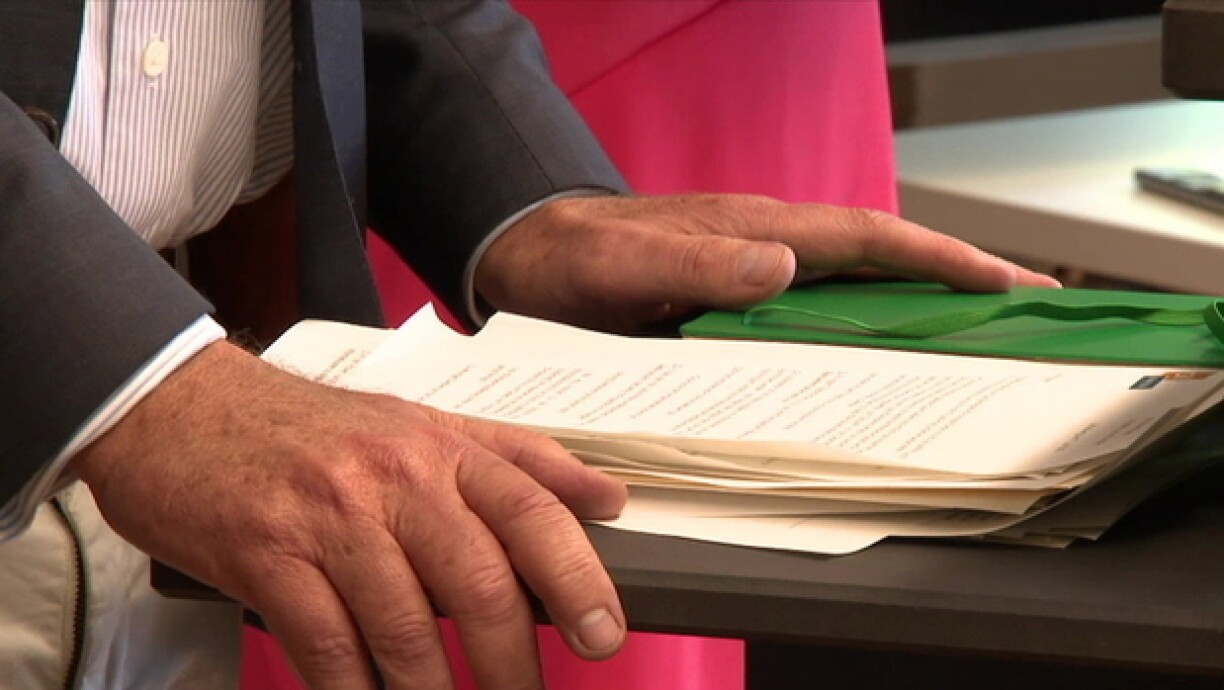
The follow-up of the so-called "casier-bis" – a sort of secret criminal record – was on the agenda of a joint judicial and internal security commission on Wednesday morning.
The prosecutor general Martine Solovieff and the public prosecutor Georges Oswald were present for a discussion with MPs.
The president of the judicial commission, Charles Margue, stressed that the position of the public prosecutor's office had been clear from the start:
"The office pointed out that it is very difficult from a technical or practical point of view to permanently delete anything because there is still a lot of paperwork involved. And the affected parties, victims and perpetrators, also have to be careful before they decide to delete something permanently."
Simone Flammang, Attorney General at the public prosecutor's office, stated only recently on RTL Radio that the right to be forgotten mainly benefited the perpetrators.
CSV-MP Gilles Roth commented on this point:
"I was shocked when I heard an attorney general state that the right to be forgotten was a problem. Because this is how it was phrased. The right to be forgotten is an international legal norm which exists in all member states of the European Union and of course this principle also applies in Luxembourg. Of course, you have to differentiate between different levels of offenses, no question about that. It is up to the legislator to stipulate case-by-case, if certain offenses will be preserved, or preserved for a longer time because of their severity whether in the context of organised crime, child abuse, or terrorist acts. But in this case, we have to establish a legal basis which would allow for the creation of special files. These could then be used in the case of sentences, or if there are serious criminal proceedings. This is very clear and understandable to everyone in this country"
Roth went on to say that the opposition was generally disappointed with the statement made by the prosecutor general:
"Last week we had a very good meeting with representatives from the police and today we thought that we were at the dancing procession in Echternach: 3 steps backwards and we are back at the same point where we were a year ago. In my opinion, the prosecutor general thought that there is not really any urgency to act. But what you have to know is that there are a number of files which are not in accordance with data protection regulations. Then they tried to say that it was necessary to systematically have access to the minutes. Only last week, François Bausch stated that 1 million of them had been destroyed"
The oppositon expected helpful suggestions for solutions, not more problems. Roth stressed that in this point the political parties – the opposition and the government – were further than some other authorities. He pointed out that the demands of his party were clear:
"You should differentiate between sentences which are also recorded in a criminal record, and between people who will later have access to people’s sensitive data. You should also stipulate that accessing illegal files is a criminal-law provision. And of course no one should have access to cases that have become time-barred, have been closed since these are files of innocent people and the presumption of innocence also applies in Luxembourg. We are living in a constitutional state and not in a state of constant suspicion"
Charles Margue stated that while differences in opinion were certainly still present, the opposition and the government agreed at least that the misuse of data stored in archives should be penalised.





