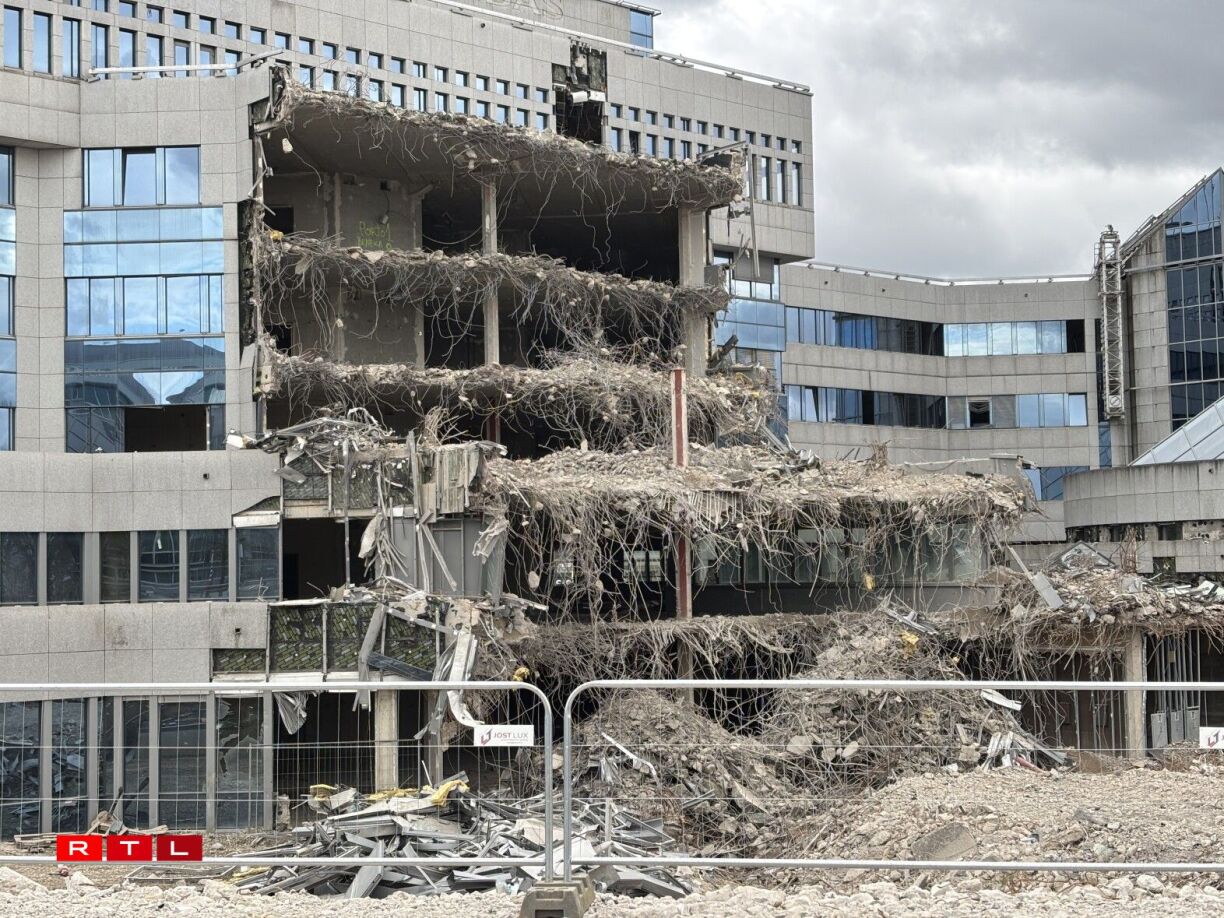
Work in Kirchberg never really stops, at least according to Marc Widong, director of the Fund for the Urbanisation and Development of the Kirchberg plateau (FUAK). The latest chapter in the district's long transformation is the demolition of the former Banque Générale headquarters, later known as the Kronos building and most recently used by BGL BNP Paribas.
In just three years' time, the site is expected to welcome the staff of multinational accounting firm KPMG into a new building that will be larger and taller than the one it replaces.


Kirchberg's transformation began in 1963 with the construction of the Grande-Duchesse Charlotte Bridge, better known as the Red Bridge, after the government decided in the 1950s to urbanise Kirchberg.
In archive footage from 1966, former Luxembourg City mayor Paul Wilwertz is shown giving a speech that outlines the idea of Kirchberg not as an isolated district, but as a district organically linked to the city's older neighbourhoods, including a broad green area extending the municipal park.
In the speech, Wilwertz explained that the area at the end of the bridge would include a zone for the European and Luxembourgish public institutions.
Over the years, construction gradually spread across the upper part of the plateau, along the motorway towards Findel, with projects such as the exhibition halls and Euromotor. Yet before Kirchberg became what it is today, it was still home to a rural community.
In archive footage, long-time resident Jos Nickels recalled that before 1960, around 750 people lived there: farmers, gardeners and labourers, including people who worked in the quarries as stonecutters and plasterers.
Nickels also looked back on what he described as a harsh period, when families were expropriated in 1961. He said the compensation offered at the time was 330,000 Luxembourg francs per hectare, an amount residents strongly opposed.
Since then, time has never stood still on the roughly 330-hectare plateau. For decades, cranes have been a defining part of the Kirchberg skyline. It was there, in the early 1990s, that the Banque Générale built its new headquarters.
In 1993, Luxembourg City mayor Lydie Polfer said the project was in line with the joint vision developed with the state for the urbanisation of Kirchberg and would help ease pressure on the city centre.
The building, with its fortress-like architecture, was designed by architect Pierre Bohler and interior architect Jim Clemes. Its large garden, which will be preserved, was laid out by Belgian landscape architect Jacques Wirtz.
All around it, Kirchberg has continued to grow larger and taller. By 2029, a new KPMG headquarters is due to rise on the site where the former Banque Générale once stood.
The project is set to provide 31,000 square metres of space for 1,800 employees, while a further 24,600 square metres of office space will be made available to rent.
With its load-bearing timber structure, the new building is intended to become yet another landmark in a district that remains in constant transformation.