
A family with three young children has lost their home after a social housing project with the Foundation for Access to Housing came to an end, with the foundation stating that the tenants had not fulfilled their commitments during the first three years.
On 30 March, Cynthia – a pseudonym used to protect her identity – handed over the keys to the family's home. Since then, she has been urgently searching for new accommodation for herself, her partner and their children, aged three, five, and seven.
The couple, both earning the minimum wage, moved into an apartment from the foundation in 2021 under a three-year agreement. They were later granted a six-month extension, but had no legal right to remain in the property after 1 July 2024. Some 21 months later, a bailiff, accompanied by police, was due to enforce the eviction.
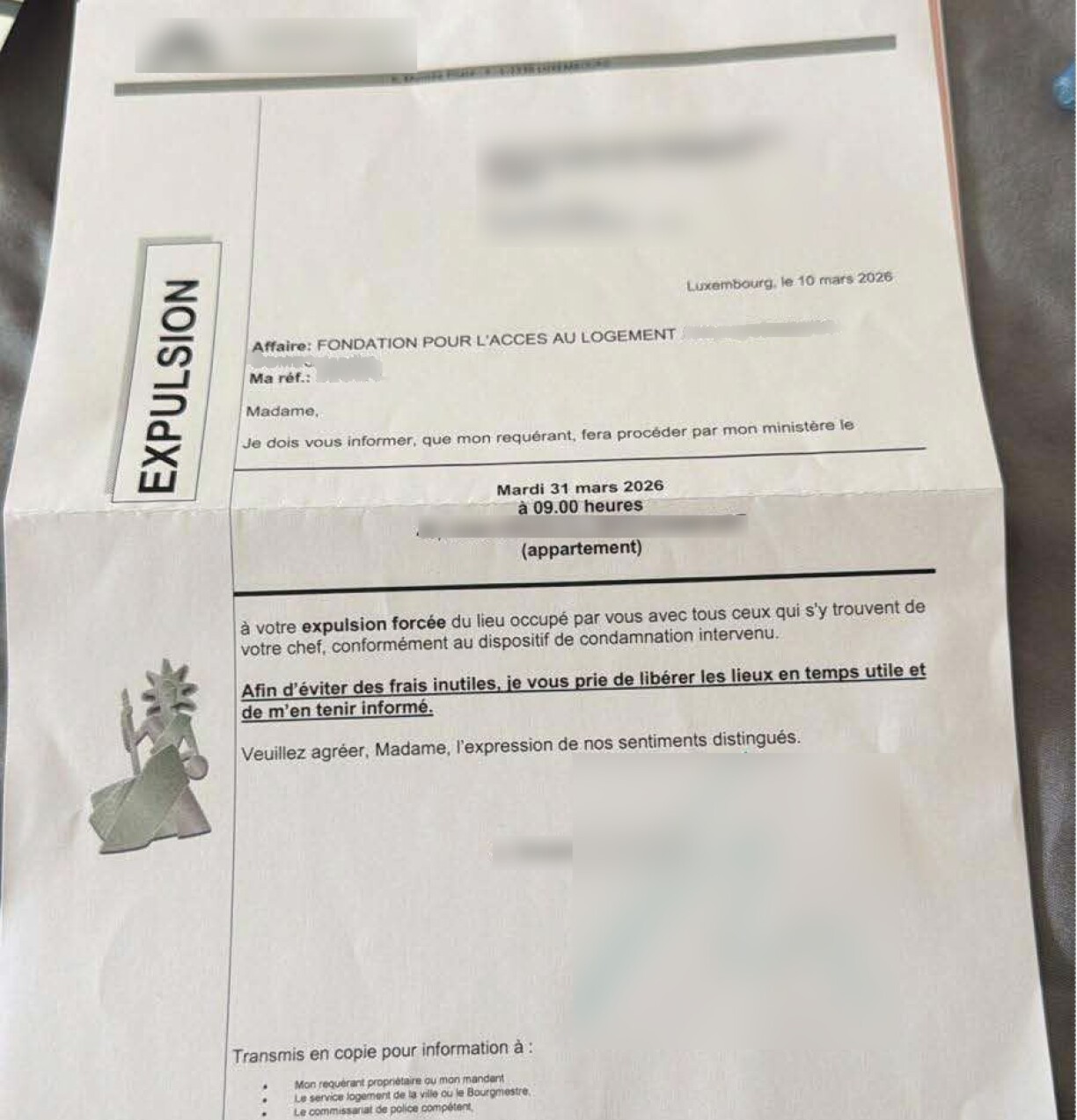
Although the official appointment had been set for the morning of 31 March, the couple chose to leave the day before to avoid exposing their children to the eviction process. They packed their belongings quietly and left without having secured alternative housing.
To shield the children from distress, Cynthia explained in conversation with RTL that she had told them they were going on a short holiday, but said they kept asking when they would be able to return home, making it difficult to distract them from the situation.
The family has since been staying in a modest hotel near the motorway in Longwy, where conditions offer little comfort. The children have limited ways to pass the time, spending most of it watching television or playing on the bed.
Cynthia has been contacting numerous estate agencies, as she had done repeatedly over recent months and even the previous year. However, she explained that before even being offered a viewing, applicants are typically asked about household size, income, and employment contracts.
She indicated that requirements often include permanent contracts and a monthly income of €7,000 to €8,000 for a three-bedroom flat, which she said is unrealistic for a household on the minimum wage.
While her partner has a permanent contract, Cynthia only recently started a fixed-term role through an employment initiative.
Cynthia explained that she was born in Cape Verde, where her family worked extensively in gardening. She said her current job is not just employment but also a form of therapy, as working with her hands and seeing tangible results helps her more than talking through her problems.
She added that her colleagues and supervisors are very supportive, creating a positive environment where they share moments of laughter and actively try to help when she is struggling.
A colleague recently put her in touch with a family, originally from Burkina Faso, that is renting out rooms, with Cynthia able to secure two rooms for up to two months at a reduced price due to her situation. She said this had brought some relief and reduced stress, although it remains only a temporary solution rather than a permanent home.
The case raises the question of why a family with three children had to leave accommodation provided through the Foundation for Access to Housing, which currently supports around 800 households in Luxembourg.
According to its director, Gilles Hempel, access to housing through the foundation is tied to a structured social support programme. This includes an initial assessment followed by a tailored plan aimed at improving the household's situation, such as managing finances, repaying debts, finding employment, pursuing training or obtaining professional qualifications.
Beneficiaries are expected to actively engage with both the foundation's social services and external support structures, according to Hempel.
Hempel explained that, in this case, the family did not adhere to their commitments during the first three years and did not actively cooperate with social services. Despite this, the foundation granted a six-month extension and intensified support efforts, but ultimately concluded that the situation had not improved sufficiently, leading to the decision not to renew the contract.
He stressed that the decision was not intended to harm the family, but rather to ensure fairness towards others in need. In addition to the households already supported, around 1,600 families are currently on the waiting list.
He indicated that if a household chooses not to engage with the support framework, it cannot remain in the programme, as places must be made available to those willing to work towards improving their situation.
Hempel also noted that, in Luxembourg, people are not simply left without assistance, as municipalities and social services remain involved. In this case, the family lived in the municipality of Steinfort, whose mayor, Sammy Wagner, confirmed that local authorities had been informed of the planned eviction.
However, due to the shortage of housing, the municipality currently has no vacant social housing available, except during renovation periods, Wagner said.
Wagner explained that the local social office had been actively seeking solutions, contacting various organisations to find short-term accommodation and exploring longer-term options. He said that, despite these efforts, no permanent solution has yet been secured, although a few potential leads are being explored.
For now, the family continues to search for housing on their own, hoping to find a stable home as soon as possible.