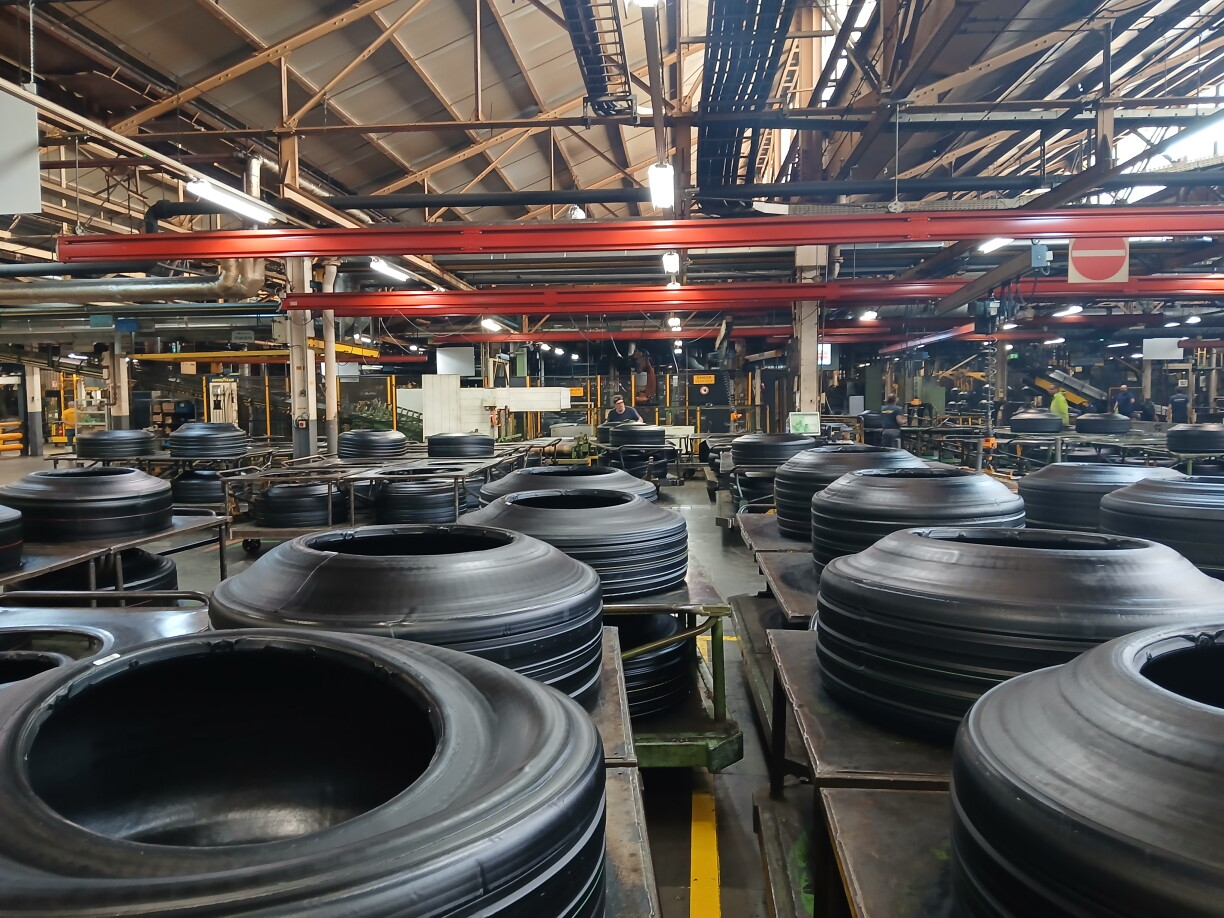
75 years ago, US tyre manufacturer Goodyear began production in Luxembourg. The milestone anniversary was celebrated on Tuesday morning at the Colmar-Berg site in the presence of Grand Duke Guillaume, among others. To maintain its market position, Goodyear is focusing primarily on innovation, though the current environment is anything but easy.
The very first tyre produced by Goodyear in Luxembourg was on display in the conference room where the celebratory speeches were held. It bears quite a few signatures from former employees, as well as something else, as Deputy Prime Minister Xavier Bettel highlighted during his address.
Bettel specifically spoke about the 'Made in Luxembourg' label, stressing that this is not a given. He said he is frequently reminded of this when drinking coffee from a Villeroy & Boch cup proclaiming 'Made in Luxembourg' and feeling proud. However, Bettel added, the case of Villeroy & Boch also shows that industry can disappear.
Goodyear, on the other hand, has no intention of doing so. Today, around 3,400 people work for the company in Luxembourg. Approximately 5,500 tyres are produced per day, mainly for lorries but also partly for diggers.
Alongside production, innovation plays an important role at the Luxembourg site. The Colmar-Berg factory is the first within the Goodyear group to manufacture tyres using silica. The new material reduces rolling resistance, leading to lower fuel consumption. However, there is another positive effect, as Production Director Alex Schumann explained.
Silica can be extracted from chemical sources such as quartz or sand, but it can also be derived from natural sources. The silica used in Luxembourg comes from the ashes of burnt rice husks. Schumann stated that in countries with high rice production, the husks are often burned – partly to generate energy – and Goodyear can take the remaining ashes to extract silica. "Which basically makes the whole thing sustainable", he said. In other words, Goodyear is making use of a material that was previously discarded.
Since the start of the Iran war at the end of February, energy prices have exploded. Goodyear has felt this impact on several levels. Schumann mentioned energy purchases, noting that while Goodyear – like many other businesses – buys energy slightly in advance, those orders eventually run out. From that point onward, the company must buy at current prices for the rest of the year.
The other areas where Goodyear has noticed the impact are transport, logistics, and packaging costs, Schumann said. However, raw material prices will almost certainly place a heavy burden on the company, he added, as the materials Goodyear uses are partly oil-based and involve significant transport and logistics.
Regarding other cost factors – such as wage indexation or the minimum wage – the company does not question these at all. Employee wages are one consideration, but finding qualified people in the first place is even more important, according to Schumann. While he believes this is certainly possible in Luxembourg, Goodyear must actively work to attract talent. To that end, the company is very active in schools, federations, and beyond to present itself as an attractive employer.
When asked about discussions surrounding accidents caused by burst Goodyear tyres, Schumann pointed out that those incidents involved tyres produced over ten years ago. At the time, Goodyear responded well and replaced those tyres in a widespread campaign over several years, he argued. He stressed that with current tyres, there is no reason for concern.





