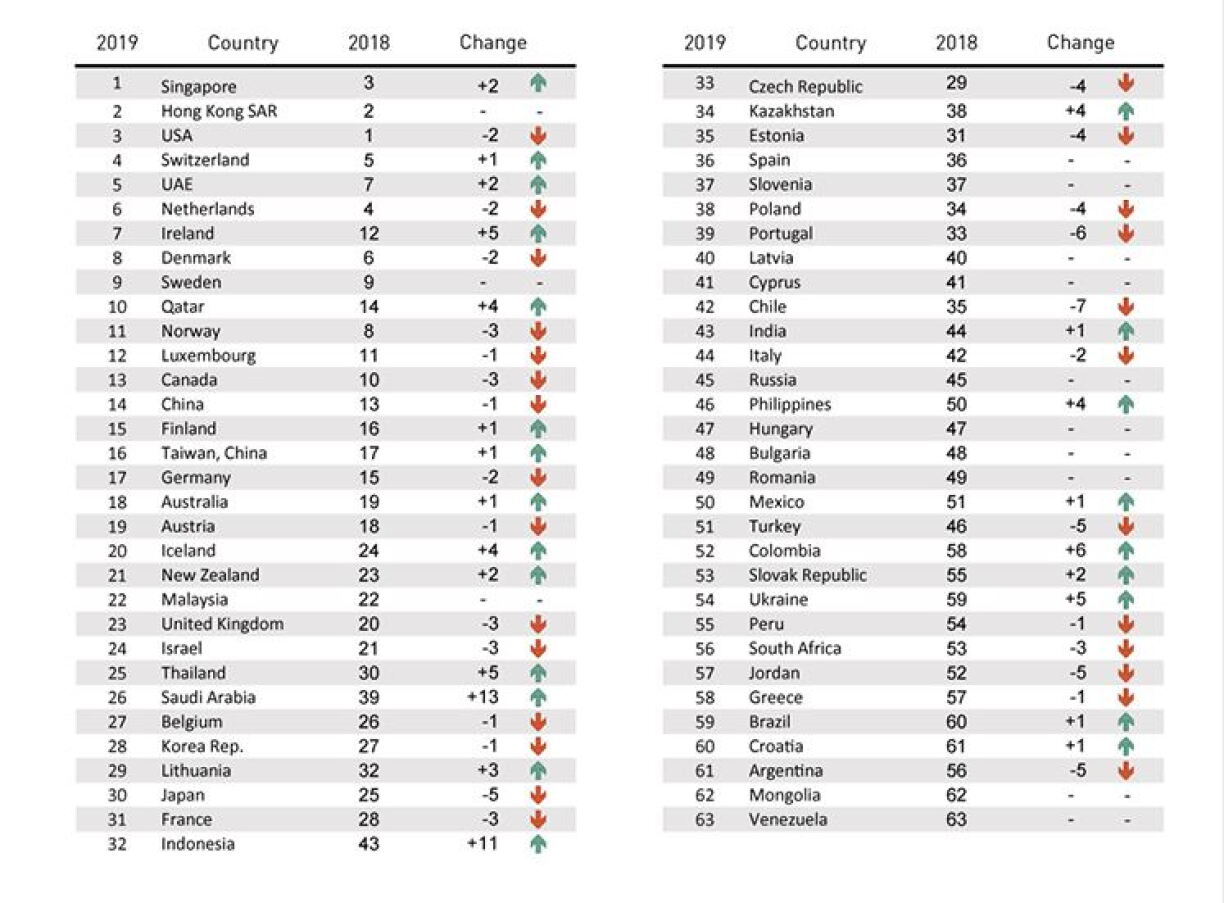
Singapore’s rise to the top is driven by advanced technological infrastructures, the availability of skilled labor, favorable immigration laws, and efficient ways to set up new businesses. Hong Kong SAR held on to second place, helped by a benign tax and business policy environment and access to business finance.
The initial boost to confidence from President Donald Trump’s first wave of tax policies appears to have faded in the United States - hit by higher fuel prices, weaker hi-tech exports and fluctuations in the value of the dollar.
The IMD World Competitiveness Rankings, established in 1989, incorporates 235 indicators from each of the 63 ranked economies. The ranking takes into account a wide range of “hard” statistics such as unemployment, GDP and government spending on health and education, as well as “soft” data from an Executive Opinion Survey covering topics such as social cohesion, globalization and corruption. This information feeds into four categories – economic performance, infrastructure, government efficiency and business efficiency – to give a final score for each country.
Economic performance
This category measures the competitive strengths of the domestic economy and its macroeconomic performance.
Government efficiency
This category measures the effect of government policies on competitiveness.
Business efficiency
This category measures how innovative, profitable and responsible businesses are in each country.
Infrastructure
This category measures how effective infrastructure is in delivering the basic, technological, scientific and human resources needs of business.