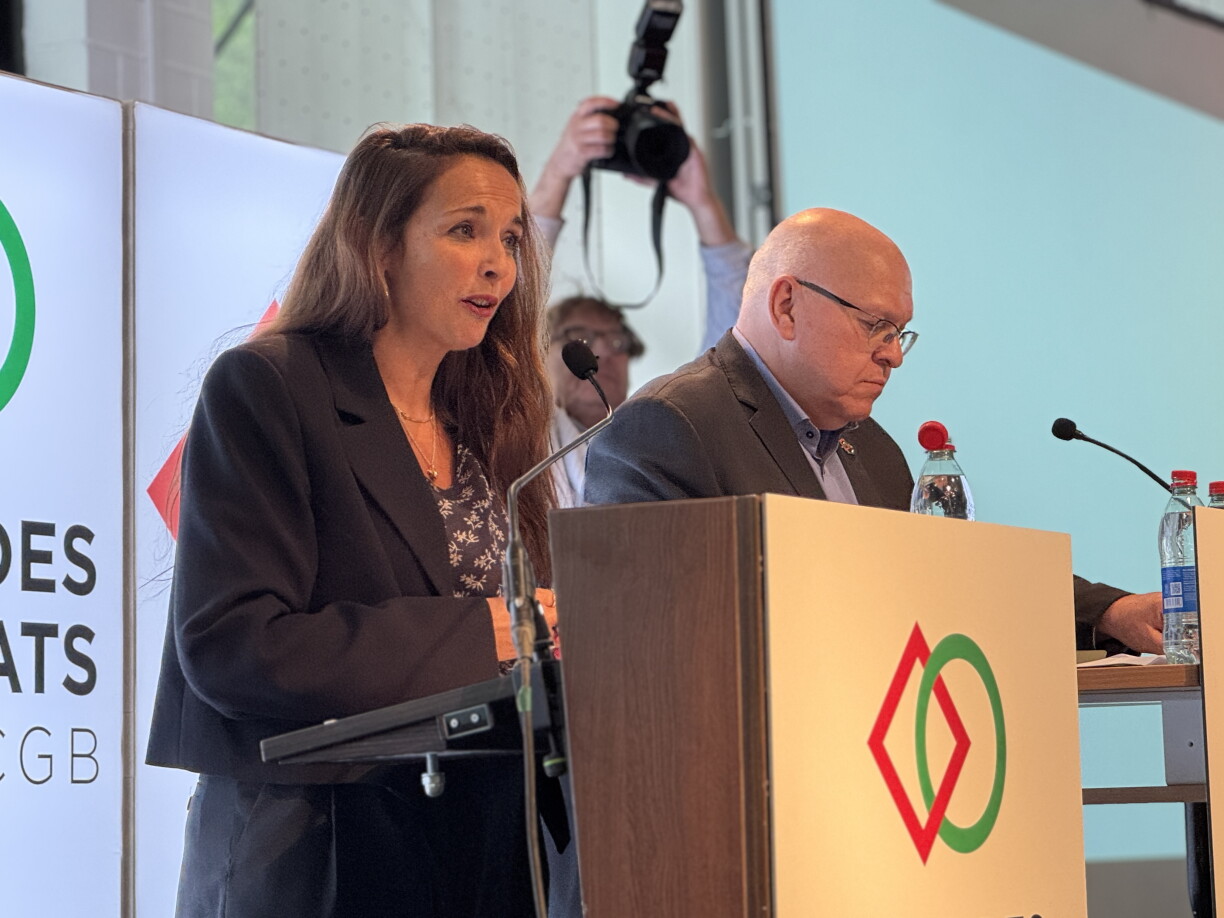
The trade union alliance between the Independent Luxembourg Trade Union Confederation (OGBL) and the Luxembourg Confederation of Christian Trade Unions (LCGB) was not satisfied with the outcome of Tuesday's preparatory meeting ahead of the tripartite talks in June.
"Not much came out of it" was the bitter assessment shared by the two presidents of the Union of Luxembourg Trade Unions on Tuesday evening. In the conference room of a hotel in Dommeldange, OGBL president Nora Back and LCGB president Patrick Dury told around 500 members how they had experienced the meeting held shortly before.
Back made her position clear from the outset, saying that the meeting had delivered very little. According to her, the government and employers had focused only on the economy: competitiveness, productivity, and energy prices. People, she argued, had not been discussed.
Yet Luxembourg had long been facing a social crisis, which could already be described as a social emergency, Back said. She pointed to poverty, the working poor, and people who can no longer afford a roof over their heads. In her view, the tripartite must not become a meeting where only an energy price cap is decided and then celebrated.
Dury stressed that the unions had entered the meeting with two major issues in mind: safeguarding the livelihoods of employees in the private sector and protecting purchasing power.
One part of this is the increase in the minimum wage, which had originally been the main topic of the Union of Luxembourg Trade Unions' rally before the preparatory tripartite meeting was scheduled.
Back criticised the government and employers for repeatedly trying to portray the unions as unreasonable for demanding a €300 increase in the minimum wage, as though this would destroy the economy or as though the unions could never be satisfied.
She argued that the additional €300 would flow straight back into the economy, rather than being used for speculation, adding that it was the super-rich who never seemed to have enough.


The unions want the tripartite discussions to be as broad as possible. Housing and social security must also be discussed, they said.
Dury warned against creating a situation in Luxembourg where people can no longer afford healthcare. He also stressed that relations with the government remained at a low point after recent meetings, saying there was no question of dialogue on an equal footing.
According to Dury, the government's decisions on both the minimum wage and platform work had been fixed from the outset, with negotiations organised only for appearances' sake.
He accused the government of trying to push the unions into a corner and discredit them. Recent polls, however, showed that two thirds of respondents considered union action important, the unions said.
Back said the unions would take to the streets and demonstrate as often as necessary until the government's "neoliberal" direction changed, and until working people and families were taken seriously again. If no agreement is reached during the tripartite negotiations, the unions will return to the streets, she said.
Dury added that the unions remained willing to negotiate, but would not allow themselves to be taken for fools.
At the end of the speeches by the two union presidents, there was loud applause and a standing ovation.
The General Confederation of the Civil Service had already reacted on Tuesday afternoon, calling for swift temporary tax relief for citizens.
According to the CGFP, it is not enough for the government to refer to its planned tax reform, as the current crisis requires rapid, short-term answers. This should include an immediate adjustment of the tax brackets to inflation, which the CGFP said was long overdue.





