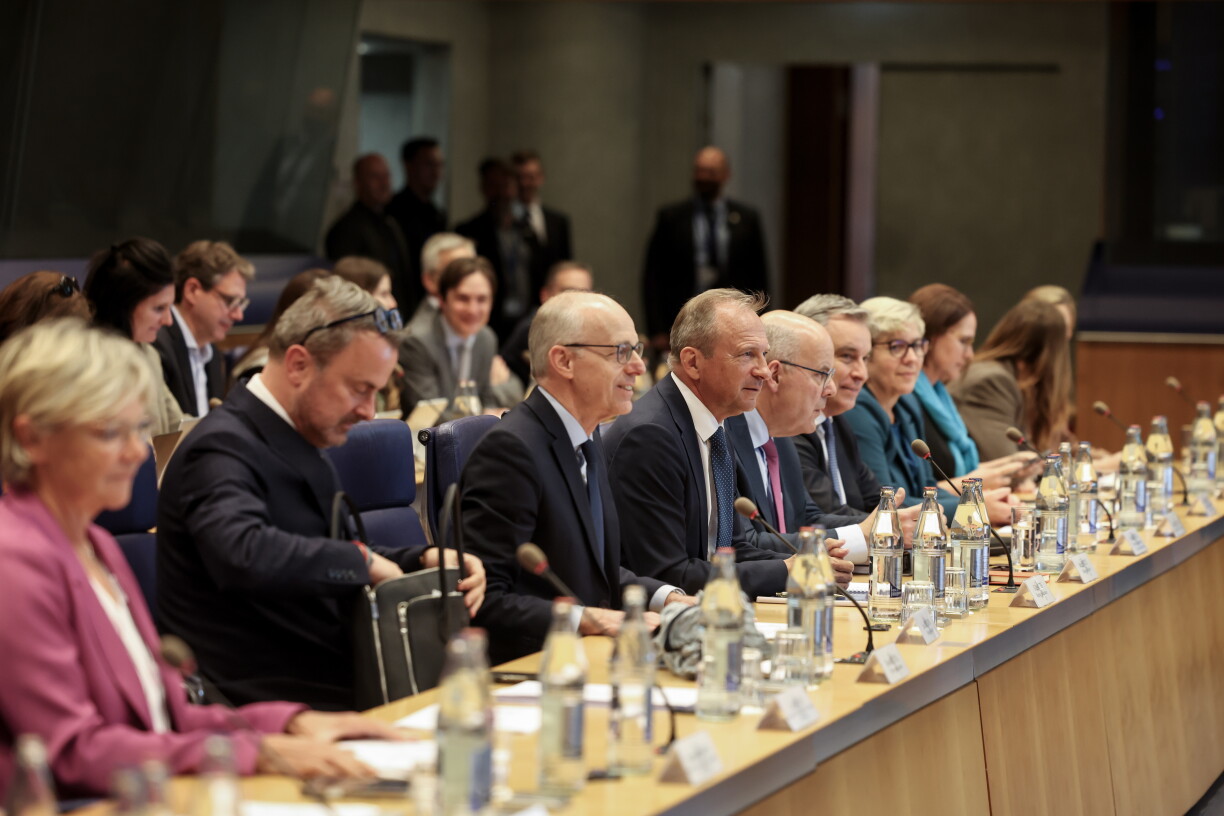
Preparatory tripartite talks between the government, employer representatives, and trade unions took place on 12 May at the Kirchberg Conference Centre, with the National Institute for Statistics and Economic Studies (STATEC) and Energy Commissioner Simeon Hagspiel presenting an initial overview of the possible economic impact of the war in Iran.
According to STATEC, a scenario in which the war in Iran lasts longer and the Strait of Hormuz remains closed until September could lead to a recession in Luxembourg as well as three wage indexation adjustments by September next year.
Two scenarios were presented: the first assumes that the war in Iran ends this month, while the second assumes that it continues until September. For the president of the Union of Luxembourg Enterprises (UEL), Michel Reckinger, the second scenario is the more realistic one.
In that case, after the indexation expected in June, another one could be triggered as early as September, followed by a third in September next year. Reckinger said this was somewhat alarming and that he expected measures to cushion the impact of inflation.
PM Luc Frieden reiterated that the wage indexation system itself was set in stone. However, when asked, he did not say whether that statement ruled out postponing an indexation adjustment or introducing compensation measures.
Asked whether the aim of the tripartite meeting was also to slow inflation, Frieden gave a negative response. The objective, he said, was to look at the consequences for people and businesses.
However, after the war in Ukraine, measures were taken to curb rising energy prices. Addressing this issue, Frieden said he had not been in politics in 2022, which was why he had focused on what the government was concentrating on now.
According to Patrick Dury, president of the Luxembourg Confederation of Christian Trade Unions (LCGB), the current energy crisis cannot be viewed in isolation. He pointed to the consecutive crises of recent years, as well as the housing shortage and unemployment, which he said were no longer only affecting people, but also the functioning of the economy.
Both Dury and Nora Back, president of the Independent Luxembourg Trade Union Confederation (OGBL), said it was too early to speak of any result or agreement. Frieden also said that there were now three weeks to assess the data and put forward proposals on how to respond to the crisis.
There were no new figures on purchasing power or public finances. Asked whether these would not be needed to obtain a complete picture and prepare measures, Frieden said that a great deal of information and many figures had already been provided. He added that STATEC would still respond to requests from the social partners.
Back also noted that one point of disagreement with STATEC had not yet been discussed: the new methodology that led to a drop in median income, which also affects the reference used to calculate the minimum wage.
For Frieden, energy supply, as well as fertiliser supply, is another focus of the tripartite meeting.
Some points from Energy Commissioner Simeon Hagspiel's presentation were striking, even if they may seem obvious: Luxembourg has no oil production or refinery of its own and imports 100% of its refined oil products, half of them from Belgium and most of them transported by road.
In the case of gas, Luxembourg is 90% dependent on imports. Oil products account for 60% of total energy consumption.
However, fuel prices at the pump are lower than in all neighbouring countries and below the EU average. The state is therefore already doing a great deal to keep prices low.
This is particularly clear in the case of electricity: without the state's contribution to network costs, electricity would be significantly more expensive for households and businesses.
Following Tuesday's meeting, there will be a three-week break before the next tripartite meeting. Until then, all sides will be able to propose measures.
The STATEC figures and the Economy Ministry's overview are available in French on the website of the Ministry of State.