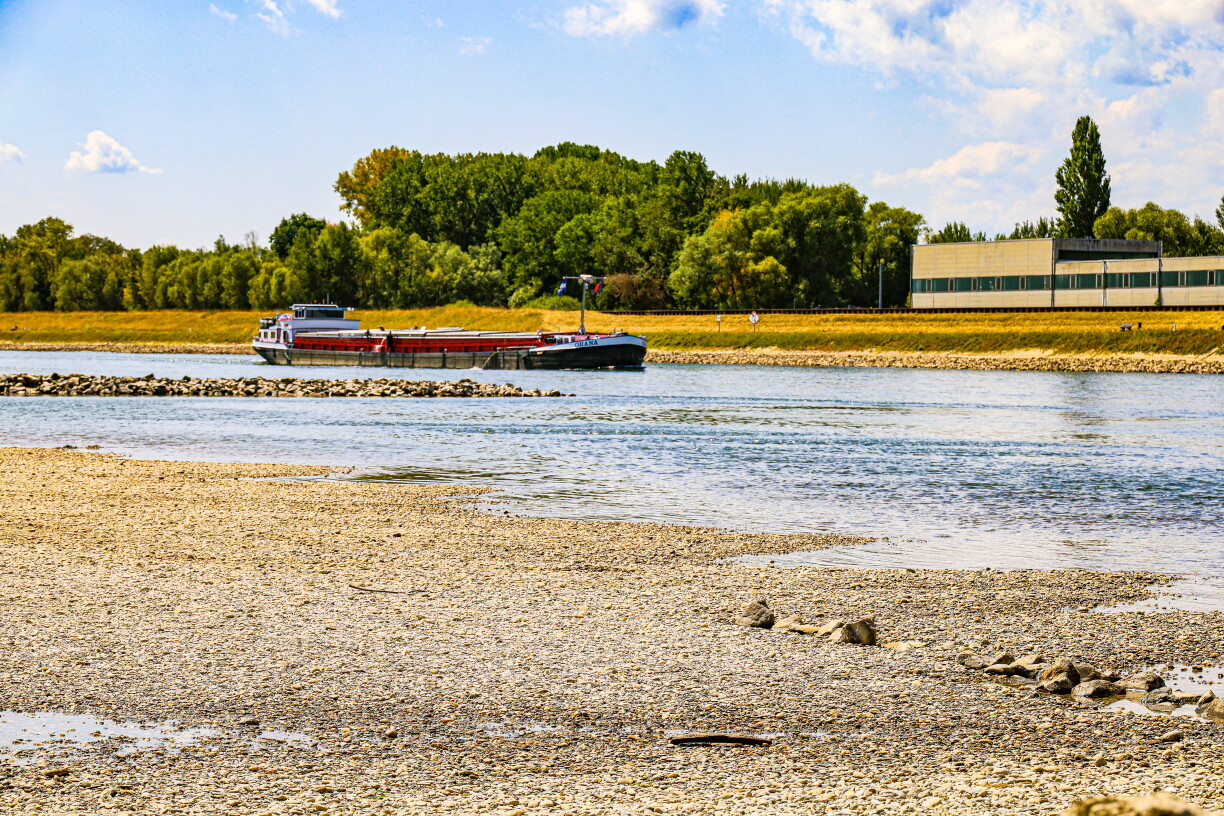
The situation is worrying, from the Loire in France to the Po in Italy and the Danube in Romania. Across Europe, rivers are running out of water.
Closer to home, the Rhine is no exception to the drought. There is no rain in sight. Beyond the purely ecological consequences, the economic impact is also becoming more and more apparent. Even in Luxembourg, where the port of Mertert is directly affected.
Weeks of heat and far too little rain mean this summer will go down as the one in which the Rhine, too, ran out of water. Levels are historically low, and not, as in the past, only sporadically at the end of summer or into the autumn, but already at the start of August.
In Bingen on the Rhine, people are worried. The ferry between Bingen and Rüdesheim is still running for now. The tourist boats that carry visitors past the Lorelei, however, have been stuck at the quayside for more than ten days. Hotel ships and large cargo vessels were the first to be forced to tie up because of the low water. In places, the so-called fairway is not even 1.40 metres deep. The knock-on effects reach far beyond the Rhine itself, up the Moselle to Mertert.
At the port, ships can currently be loaded, but only to between 25% and 30% of capacity, explained Gilles Braquet, general director of Luxport. That has to be seen against a backdrop of ships that can carry up to 2,000 tonnes, which in the present conditions are loading around 450 to 500 tonnes. Room for manoeuvre, he added, is limited.
There is also barely any current on the Moselle. The locks, however, help to keep water levels in check. The Rhine, by contrast, is a roughly 700-kilometre waterway between Rotterdam and Basel with no such locks, along which petroleum products, sand, fertiliser, steel and containers of goods are moved every day. By the end of the week, six more ships are expected in the port of Mertert, arriving up the Rhine with reduced loads. The rest of the cargoes will have to be rescheduled.Braquet said the port had a major advantage in being trimodal. That means everything that cannot currently be moved by ship can be shifted onto rail or lorries, which has worked reasonably well. Capacity can therefore be moved from one mode to another, so that clients can still be served.
The risk remains, however, that supply chains will fall out of sync. There is of course a cost difference in how many tonnes are shifted by which mode. Below 400 tonnes, water transport can barely hold its own. In times like these, meanwhile, it is a challenge to mobilise enough lorries or rail wagons to make up for the ship. The very real risk is that the whole transport chain will get out of step the longer the low water levels persist. One of the more sensitive categories of goods here is petroleum products. Prices are already rising in western Germany. Nationally, meanwhile, we've already seen very brief, local delivery disruptions.