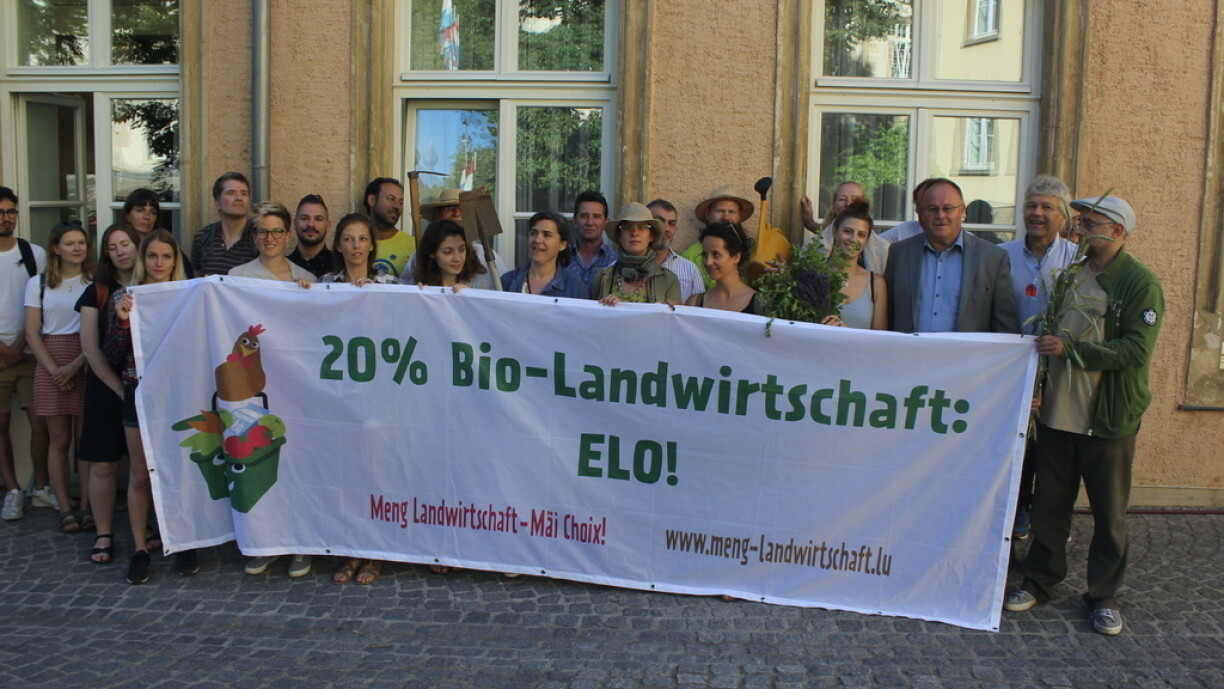
The group has taken issue with the government's lack of action compared to its commitments. 20% of Luxembourg's agriculture is expected to adhere to organic farming standards by 2025. According to "Meng Landwirtschaft", the government has not yet done much to achieve this goal.
The group accosted Minister of Agriculture Romain Scheider on Friday as the minister was on his way to the Chamber of Deputies, urging him to finally take action.
Despite the government's aim to have 20% of farmers using organic methods by 2025, the current proportion remains unchanged at 4%. Coordinator Laure Cales said the platform welcomes the government's goal but the group remains impatient.
"Meng Landwirtschaft" has many ideas concerning the promotion of organic farming and would like to put them into practice. Schneider suggested a meeting scheduled for 11 July to devise an action plan for organic farming in Luxembourg.


"Meng Landwirtschaft" also had a direct request for the minister: namely, that the ministry should create a role for a contact person for matters relating to organic farming. This person could then provide meaningful support, especially for farmers who are trying to make the change from conventional to organic farming. The group stressed that the person should be good at networking in order to maximise collaboration with a large number of people.
Guy Arend, an organic farmer from Pétange, explained the importance of organic farming in relation to insect biodiversity. Conventional farming practises endanger many insect species, as well as other animals. Organic farming, on the other hand, is a means of protecting this wildlife.
The change would not just benefit farmers, but also improve the general image of the country: Luxembourg would become a hub for natural food production and nature - a perfect way to attract tourists.
Consumers in Luxembourg buy a lot of organic produce. Arend highlighted that the dearth of organic farmers means a lot of organic produce needs to be imported.
According to Marc Fisch of Centrale Paysanne Luxembourgoise, the agricultural sector is open to the possibility of organic farming, but needs have guarantees as to the industry's future. While consumers may claim they want to buy more organic produce, this does not necessarily translate to more purchases. Sometimes, organic products are left sitting on the shelves, as is often the case for organic milk.
Fisch believes the government aim of 20% organic farming by 2025 is ambitious but not necessarily realistic. As he explained, if the market does not cooperate, it will be very difficult to reach this goal. However, Fisch's scepticism does not mean he does not support the idea. He believes that opening markets would certainly benefit the agricultural sector, but ultimately, organic farming depends on consumer demand. This is also linked to prices, which are higher for organic products, as they incur higher production costs.
Sales of organic products in Luxembourg are higher than the country's output of organic products, which lays at around 4%. Fisch added that not all organic products made in Luxembourg ends up on people's plates in the country. He cited dairy as an example: half of the dairy produced in Luxembourg is exported. This applies to both conventional and organic milk (the latter makes up just 1% of total production). The situation for meat is very similar.
Marc Fisch reiterated that he is in favour of the action plan for organic farming, but stressed the importance of both advice and awareness.
Luxembourg counts some 1,800 farms, out of which 70 are organic. Overall, the number of farms is falling, mostly due to an ageing farming population. Roughly 30 to 40 farms are closing every year.





