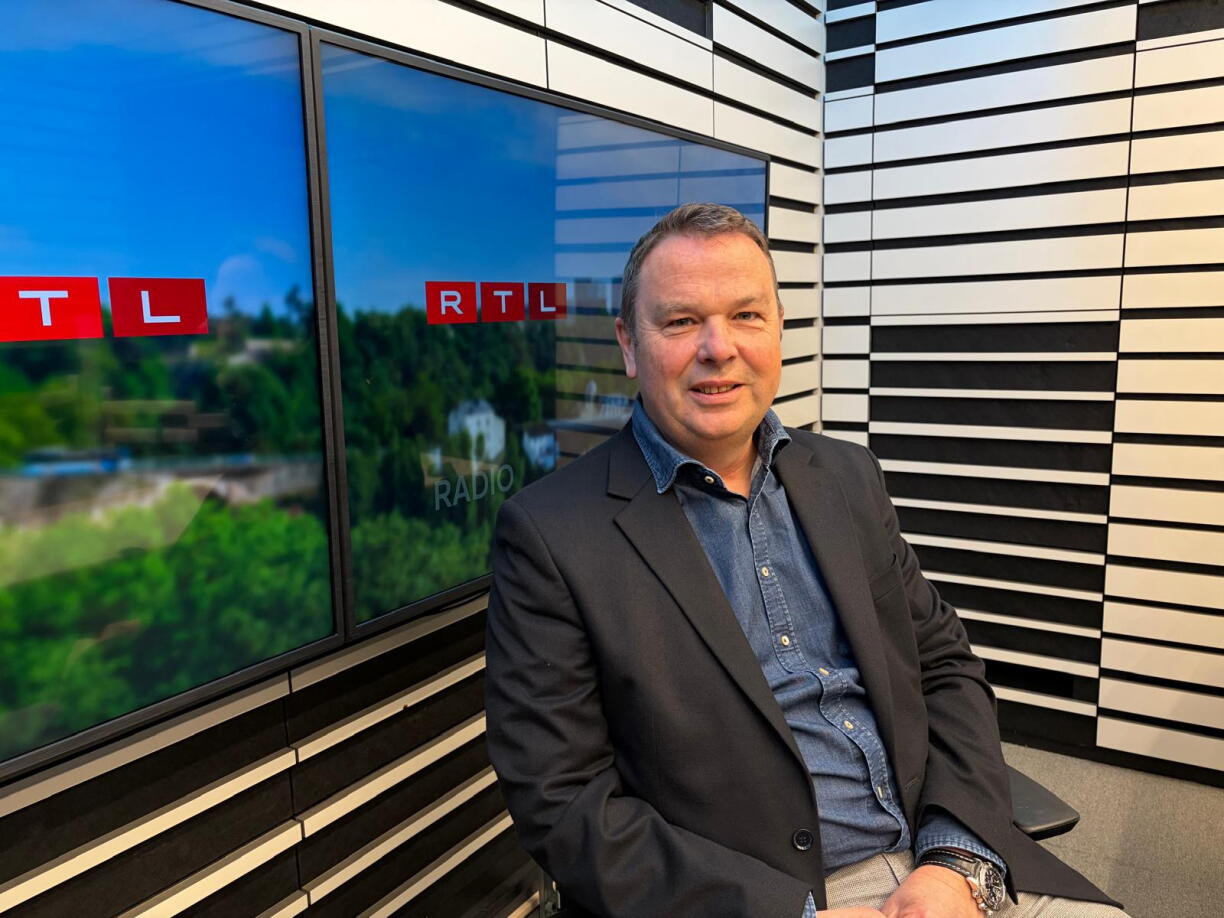
The first round of preparatory meetings for Luxembourg's tripartite negotiations brought together representatives from the government, employers, and trade unions at the conference centre in Kirchberg, with the Union of Luxembourg Entreprises' (UEL) interim coordinator René Winkin stressing the importance of rigorous preparation.
This morning, he said to have insisted on a "well-prepared tripartite", if one is created, underlining the need for clear and shared understanding of Luxembourg's economic situation before moving forward.
Winkin explained that the presentation of new data by the National Institute of Statistics and Economic Studies (STATEC) and the Energy Commissioner Simeon Hagspiel had provided a more nuanced picture of current risks, especially in light of international tensions.
While the government, employers, and trade unions agree on the urgency of the challenges, their main concerns differ. Trade unions, including the Independent Luxembourg Trade Union Confederation (OGBL) and the Luxembourg Confederation of Christian Trade Unions (LCGB), see risks of a social crisis, while employers are primarily focused on economic threats.
Despite these differences, Winkin argued for a unified approach, emphasising that economic and social performance are mutually dependent. He explained that "economic performance influences social performance and vice versa", and he noted that when people are motivated and well paid, they tend to work effectively.
The UEL coordinator noted that scenarios shown were not firm forecasts, but allowed participants to anticipate possible developments and test responses.
Much depends on how the war in Iran develops and whether the Strait of Hormuz remains blocked. Depending on the scenario, oil, and gas prices could rise more or less sharply, inflation could reach 3% or 6%, and Luxembourg could see up to three wage indexation adjustments by September 2027.
Winkin stressed the importance of timing and anticipation. In the more severe scenario presented by STATEC, a further indexation adjustment could be triggered this year, possibly even before December, followed by another one next year, he said.
He argued that if the aim is to slow or correct the impact of high inflation, as set out in the government programme, it is not too early to begin discussing measures. Otherwise, the country could end up reacting at the last minute and in a rush, he said.
According to Winkin, possible measures should now be put on the table ahead of the meetings on 2–3 June, simulated, and assessed for their effectiveness.
Asked whether measures should be taken before prices rise sharply, even though it is not yet certain how far they will rise, Winkin said businesses are already seeing costs increase.
Speaking from the perspective of industry, but also referring to crafts and commerce, he forecasts that rising costs would eventually be reflected in prices; some effects may only become visible after six months or more.
For example, if packaging material becomes 50% more expensive, the packaged product will eventually also become more expensive, even if not immediately, according to Winkin. For him, there is already enough information to know that Luxembourg is dealing with inflationary pressure.
Winkin sees a possibility in "slowing down inflation" through measures, falling back on successful examples of 2022 and 2023 that STATEC had unveiled during the meeting. He added that if these measures proved insufficient, "corrective steps" would be needed, explaining that in such a case one would need to consider where adjustments could be made, whether an index tranche should be altered, whether compensation was necessary, or if it could be done through "other means".
He stated that that the higher up one intervenes in that cascade, the more effective it is for each euro invested, compared with attempting to manage it only "at the bottom".
Asked how much financial room the state has to support businesses and households, Winkin said the government had not given a specific presentation on public finances during Tuesday's meeting, apart from the contributions by STATEC and the Energy Commissioner.
However, he noted that the state of public finances is already broadly known and that Finance Minister Gilles Roth has spoken about it on several occasions. The issue will certainly come up during the negotiations, he added.
Winkin said PM Luc Frieden had acknowledged that this is an exceptional situation and that Luxembourg must consider how to give itself the means to respond. The financial room for manoeuvre may not be as large as it was 10 years ago, he said, but the employers' side was told that some room still exists.
Looking ahead to the main tripartite session on 2–3 June, Winkin called for more targeted proposals and closer coordination among stakeholders. He suggested that both employers and trade unions should continue discussions to clarify their respective positions and test the feasibility of potential measures, especially regarding company support and compliance with EU rules.
He also stressed his preference for joint progress, saying that he would rather advocate for dialogue and trying to establish a "common path". He added that when it comes to the crisis itself and how people and businesses can be helped, he could not see why there should be miles apart between them and the unions.
Winkin welcomed the unions' call for issues such as housing, health and the minimum wage to be discussed, but expressed concern about overloading the agenda, raising the question of whether every "important subject" must go to the Tripartite, and whether there is the "time and capacity" to move forward more quickly and effectively than all the construction sites surrounding housing, noting that for now the focus should be on housing.
The interim coordinator also made clear that recent decisions on the minimum wage should stand, but he also highlighted that depending on what happens with the minimum wage, jobs could be at risk. This would also be a "concern" that comes to the table from the unions.
The question of indexation remains unresolved. Wanker said this would ultimately be a political decision and referenced Prime Minister Luc Frieden's recent remarks that the index was "a set in stone", but noted that various options, from delaying or capping the index to alternative compensation, remain on the table. If action is taken, one should try to consider what can be done to slow down inflation, adding that this would make the issue less urgent. He emphasised that the main focus should remain on "inflation and business impacts".
Asked about the UEL itself, which is currently going through a transition period, Winkin explained that the UEL has a president and a designated future president who will take office in October. The organisation is supported by eight member structures, several of which are sharing interim responsibilities.
Winkin said his role is to coordinate during this transition period, but confirmed that the UEL is looking for a new director and that he will not take up that position.
He added that the employers' organisations had been strongly represented at Tuesday's meeting to show how important the process is to them. The UEL, he said, wants to stand together and work towards a result that helps the country and the people employed by its member companies.





